

GST Registration & Basics
How to Find HSN Code of Any Product in 2 Minutes (Official GST Portal Method)How to Find HSN Code of Any Product in 2 Minutes (Official GST Portal Method)
Written by Shubham Jain

GST has changed how India taxes goods and services. It brought several indirect taxes under a common framework and introduced a system that allows eligible businesses to claim input tax credit. However, businesses still face challenges with filing returns, maintaining records and understanding tax rules.
If you are searching for what is gst advantages and disadvantages, this guide explains the benefits and limitations with simple examples. You will also learn how GST affects consumers, small businesses and business owners in India.
GST offers input tax credit and a simpler tax structure, but it also brings compliance costs and filing challenges for businesses.
Goods and Services Tax (GST) is an indirect tax charged on the supply of goods and services. India introduced GST on 1 July 2017, replacing several earlier central and state indirect taxes.
India has three main types of GST:
GST also provides an input tax credit (ITC) mechanism. Eligible registered businesses can use qualifying GST paid on purchases to reduce their output tax liability, subject to applicable legal conditions.
For more information, read the official CBIC guide to GST.
Understanding what is gst advantages and disadvantages starts with knowing that GST can simplify some tax processes but does not remove every compliance responsibility.
The main advantages of GST include a more unified indirect tax framework, eligible tax credits and digital compliance. The actual benefits depend on the type of transaction and the business's ability to follow the applicable rules.
The cascading effect happens when a tax becomes part of the cost on which another tax is charged. GST's input tax credit mechanism helps reduce this effect when credit is legally available.
Example: A registered trader buys taxable goods for resale. If the purchase qualifies for input tax credit, the trader may use the eligible credit to reduce the GST payable on sales.
GST provides a common framework for taxing supplies across India. This can make interstate business operations easier to organise, although businesses must still follow applicable invoicing and compliance requirements.
Businesses can use the GST portal for applicable registration, return filing, tax payments, and other services. Digital records can make it easier to organise invoices and review transactions.
GST invoices show the taxable value and applicable tax details. These records help buyers understand the tax charged and help businesses maintain clearer transaction histories.
Businesses that meet the applicable conditions may claim credit for qualifying GST paid on purchases. This can reduce the effective tax cost on eligible business transactions.
GST compliance encourages businesses to maintain purchase invoices, sales records and tax information. Well-organised records can support reconciliation and financial reporting.
These are some of the key advantages and disadvantages of gst to consider when evaluating how the tax system affects a business.
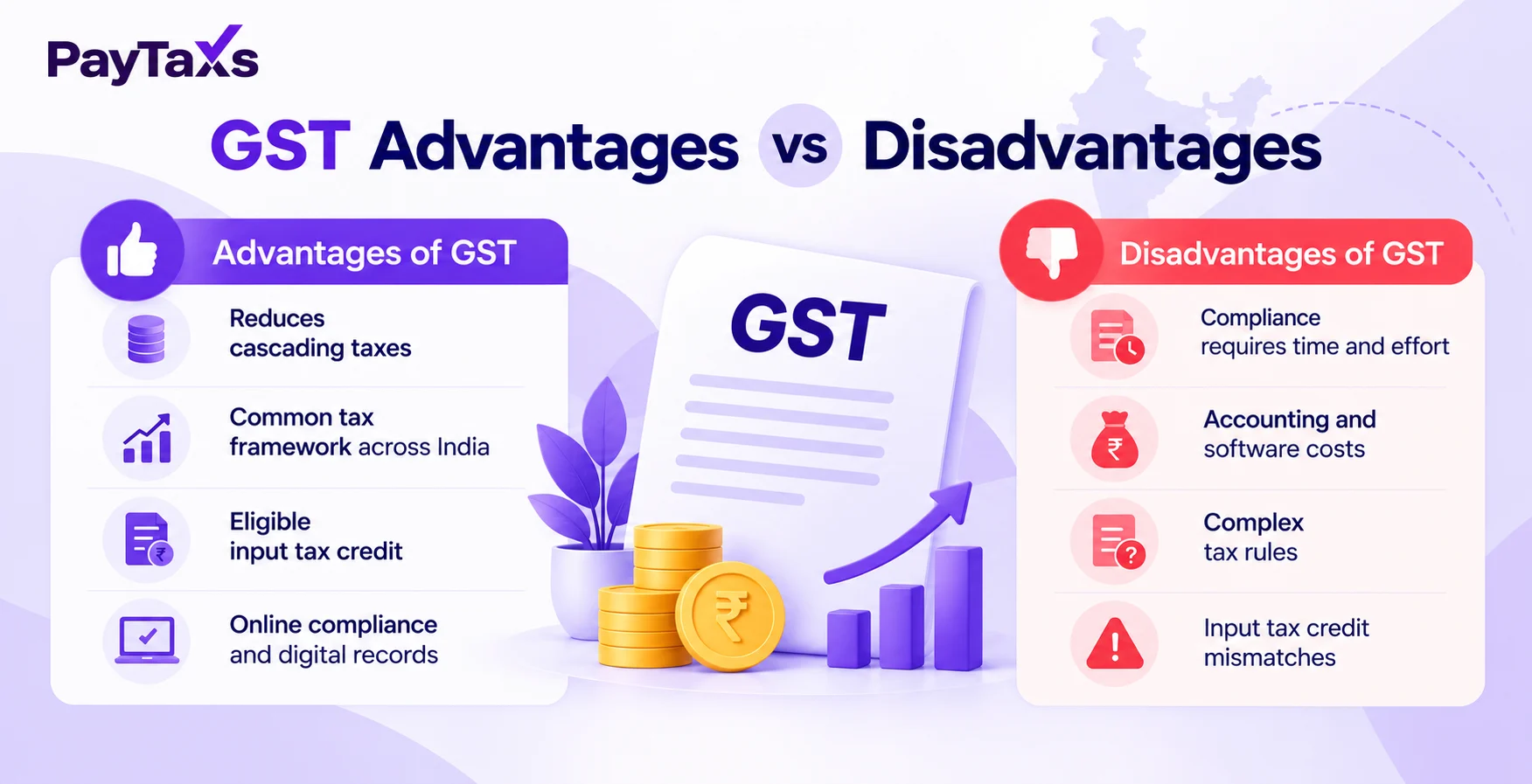
The advantages of GST include a common indirect tax framework, eligible input tax credit and digital tax administration. Here are ten key benefits for Indian businesses and consumers.
The actual benefits depend on the business, the type of supply and the applicable GST provisions. GST does not automatically reduce costs or prices for every business or consumer.
The disadvantages mainly involve compliance workload, accounting costs and the need to understand tax rules. These issues can be particularly challenging for small businesses without dedicated accounting staff.
Businesses must complete the returns and other obligations applicable to their registration and activities. Preparing records, reconciling invoices and meeting deadlines can take time.
Some businesses need accounting software, employee training or professional assistance to manage GST correctly. These expenses can affect startups and small traders with limited budgets.
GST treatment may depend on the nature of the supply, place of supply, registration status and applicable provisions. Incorrect classification can lead to invoicing and reporting errors.
Differences between purchase records, supplier-reported invoices and accounting books can create reconciliation problems. Businesses must investigate discrepancies and verify credit eligibility.
Online filing can reduce paperwork, but businesses still need accurate data and the ability to resolve technical or reporting issues.
The final price depends on the applicable tax rate, eligible credits, business costs and pricing decisions. Some products or services may become cheaper, while others may become more expensive.
The top 10 disadvantages of gst can be summarised as follows. Their impact varies according to the size, sector and tax profile of a business.
The disadvantages of GST in india can be more noticeable for businesses that lack a regular accounting process. Keeping records updated and checking transactions frequently can help reduce avoidable errors.
GST can help small businesses organise tax records and claim eligible input tax credit. However, compliance may require additional time, money and technical knowledge. Consider a retailer in Jaipur who buys goods from a supplier and sells them to local customers. The retailer needs to record purchases and sales, check the applicable tax treatment, reconcile eligible credits and complete the required returns.
A simple compliance routine can help:
For small businesses, the advantages and disadvantages of gst depend partly on how effectively they manage these responsibilities.
If you need more detail about matching records, read the Paytaxs GST reconciliation guide.
Consumers may see GST reflected in the final price of taxable goods and services. However, GST does not automatically increase or decrease every price.
For example, a change in the applicable GST rate may change the tax component of a product's price. The final amount also depends on the pre-tax price and the seller's other costs.
Consumers should check invoices for the taxable value, applicable GST and total amount payable. This helps them understand what they are paying rather than assuming GST always makes goods more expensive.
A comparison graphic can help readers quickly understand the main benefits and challenges. For people searching for advantages and disadvantages of gst images, a clear infographic can make the information easier to scan.
Businesses can reduce avoidable errors by following a consistent process instead of waiting until a filing deadline.
For more guidance, explore Paytaxs GST services to learn about available compliance support.
Get clarity on GST compliance, returns, and tax requirements with Paytaxs.
GST has brought several indirect taxes under a common framework and introduced a system for eligible input tax credit. At the same time, businesses must maintain records, understand applicable rules and meet their compliance responsibilities.
Understanding what are the advantages and disadvantages of GST helps business owners make informed decisions about accounting, pricing and compliance. The best approach is to maintain accurate records, reconcile regularly and seek help when necessary.
Disclaimer: This article is for general educational purposes only. GST treatment depends on the facts of each transaction and the applicable laws, rules and notifications. Consult a qualified professional for advice on your specific circumstances.
Note: This guide is for information purposes only. The views expressed in this guide are personal and do not constitute the views of Paytaxs. Paytaxs or the author will not be responsible for any direct or indirect loss incurred by the reader for taking any decision based on the information or the contents. It is advisable to consult either a CA, CS, CPA or a professional tax expert from the Paytaxs team, as they are familiar with the current regulations and help you make accurate decisions and maintain accuracy throughout the whole process.
Hatim Dudhiyawala is a Certified Public Accountant (CPA) with SaveTaxs and specializes in Indian and NRI taxation. He advises individuals, NRIs, and businesses on income tax filing, capital gains taxation, DTAA benefits, fund repatriation, and tax compliance. With experience in cross-border tax matters, Hatim helps taxpayers understand complex regulations and make informed decisions. Through his articles, he shares practical insights to help readers stay compliant and manage their tax obligations with confidence. See Full Bio
Want to read more? Explore Blogs