


GST Compliance & Updates
Self Invoice Under GST: New RCM E-Invoicing Rules ExplainedSelf Invoice Under GST: New RCM E-Invoicing Rules Explained
Written by Hatim Dudhiyawala
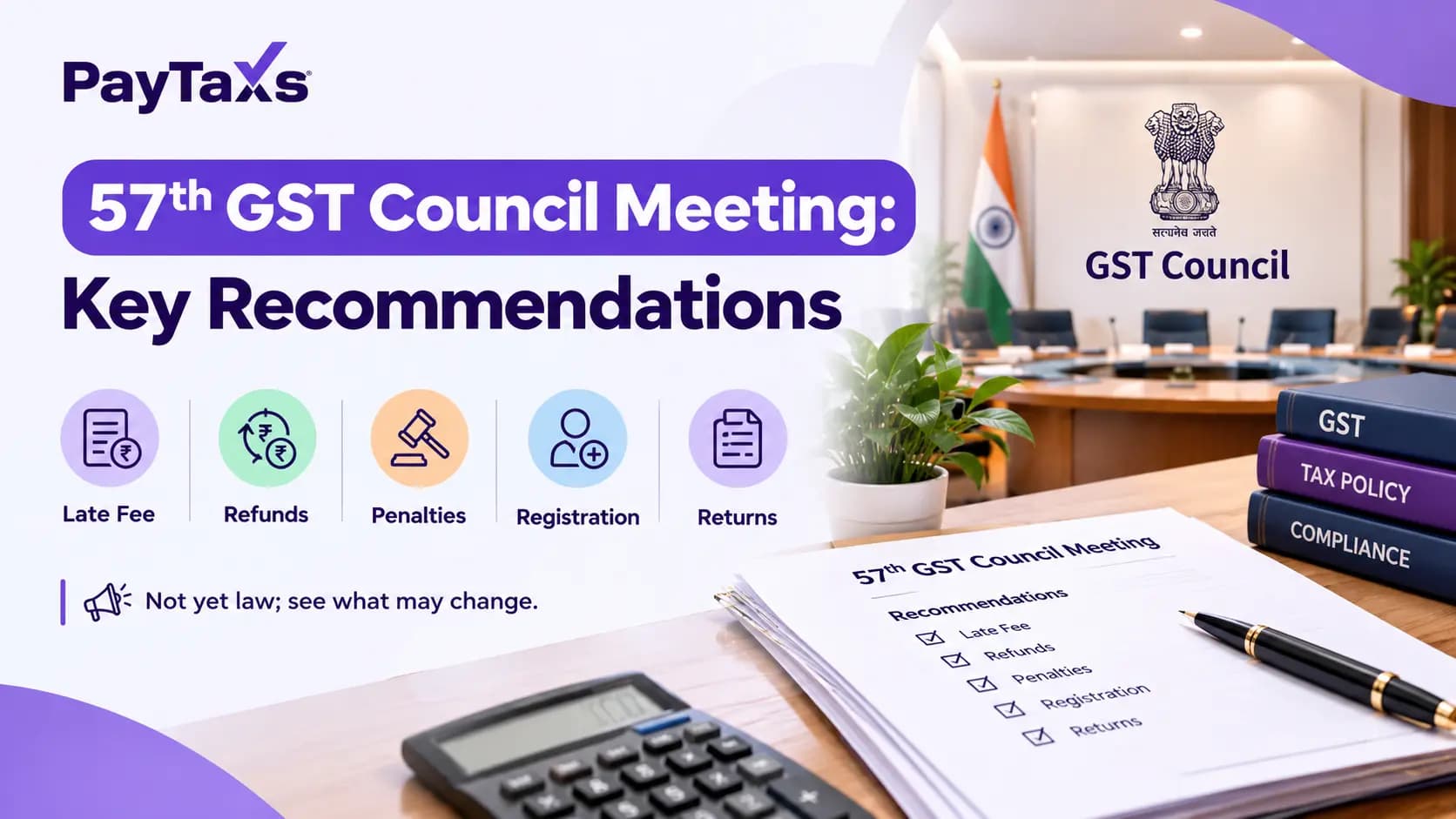
The GST Council held its 57th meeting on 8 October 2026 in New Delhi. The 56th meeting last year was mostly about rate cuts and rate rationalisation. This one was about something more day to day: how GST actually works for you when you register, file returns, claim a refund or get a notice from the department. If you run a shop, a small company, a startup or a freelance business, a few of these recommendations could change how you deal with the GST portal. If you are a commerce, CA, CMA or CS student, this is a good real-life case of how a GST rule gets changed.
Please read this before anything else: everything in this post is a recommendation of the GST Council. A recommendation is not law yet. It becomes law only after the government issues a notification or circular, or amends the CGST Act or Rules. Until then, the current GST rules continue to apply. Each section below tells you three things: what was recommended, what it means in plain words, and who it matters to.
The GST Council is the body that decides how GST should work in India. It is chaired by the Union Finance Minister and includes the finance ministers of the states. When it decides something, the decision is called a recommendation.
A recommendation has to travel a few steps before it touches your business:
In simple words: the Council gives the direction and the notification gives the date. Until the notification comes, nothing changes for your return or your registration.
|
Area |
What was recommended |
Who it matters to |
|---|---|---|
|
Late fee |
Waive late fee on a delayed return under section 39(1) if it is filed by the end of the due month |
Taxpayers with turnover up to ₹5 crore |
|
Refunds |
More automatic refunds, 90% provisional refund in some cases, acknowledgement in 10 days |
Exporters, businesses with inverted duty, anyone with extra cash ledger balance |
|
Penalty |
Maximum general penalty (section 125) cut from ₹25,000 to ₹10,000 |
All taxpayers |
|
Notices |
No show cause notice where the tax involved is below ₹10,000 |
All taxpayers |
|
Arrest and prosecution |
Omit section 69 (arrest); raise the prosecution threshold from ₹1 crore to ₹5 crore |
All taxpayers |
|
Registration |
Clear document list, easier amendments, automatic cancellation, simple route for small e-commerce sellers |
New businesses, e-commerce sellers |
|
Returns |
New way to correct liability and ITC, proposed from the April 2027 return |
Regular return filers |
|
Input tax credit |
Some blocked credits released, refund of accumulated ITC in some cases |
Businesses buying catering, insurance, capital goods |
|
E-invoicing |
Extended to reverse charge purchases and import of services, for turnover of ₹5 crore and above |
Larger small businesses |
|
ARQP scheme |
Optional annual return with quarterly payment, approved in principle |
B2C businesses up to ₹5 crore |
The Council recommended waiving the late fee on a delayed return filed under section 39(1) of the CGST Act. The relief is for taxpayers whose annual turnover in the previous financial year was up to ₹5 crore. The condition is that the delayed return is filed by the end of the month in which it was due.
In simple words: if you are a small taxpayer and you file a few days late, but still inside the same month, you may not have to pay the late fee.
Say Ravi runs a trading business and his turnover last year was ₹2.8 crore. His return was due on the 20th and he files it on the 27th of the same month. Under this recommendation, no late fee would apply to him once it is notified. If Ravi files on the 2nd of the next month, the relief would not apply, because the return came after the month had ended. This is only an example to explain the idea. It is not a statement about any actual due date.
This mainly helps small traders, service providers, freelancers and startups with turnover up to ₹5 crore who now and then miss the due date by a few days.
Waiting for a refund blocks your working capital, and exporters feel this the most. The Council recommended that refunds should be processed by the system, with less need for an officer to step in. The plan has two phases.
In simple words: the portal will do more of the checking and approving, so refunds are meant to reach you faster.
The electronic cash ledger is the account where you deposit cash to pay GST. If you deposit more than you needed, the extra balance can be claimed back. Under Phase 1, a full claim for this balance would be sanctioned automatically, without an officer.
Zero-rated supplies mostly means exports and supplies to SEZs. An inverted duty structure means the GST you pay on your inputs is higher than the GST you charge on what you sell.
For both kinds of refund claims, 90% of the amount claimed would be sanctioned provisionally and automatically, after a risk check by the system. For example, if you claim ₹10,00,000, the system could release ₹9,00,000 on a provisional basis.
The time for the officer to issue an acknowledgement or a deficiency memo (a note listing what is missing in your application) would come down from 15 days to 10 days. If the officer does neither within 10 days, the system would treat the application as acknowledged.
Quick reminder on the three taxes: CGST and SGST are charged on sales within a state, and IGST is charged on sales between states and on imports. Refund of unused ITC on capital goods and input services is explained in the input tax credit section below.
Exporters of goods and services, manufacturers with an inverted duty structure, and any business that has put extra money in its cash ledger.
This part of the meeting drew the most attention. The recommended changes aim to reduce litigation and fear for ordinary taxpayers, while keeping strong action against real fraud.
A show cause notice is a letter from the tax department asking you to explain why you should not pay extra tax, interest or a penalty.
The Council recommended that no notice should be issued if the tax involved is below ₹10,000. This amount counts CGST, SGST, IGST and Cess together. Notices and appeals below ₹10,000 that are still pending when the provision starts would be decided as if the limit had applied from the beginning. For example, a demand of ₹8,000 would not lead to a show cause notice. A demand of ₹12,000 still could.
In simple words: very small tax demands should stop turning into notices.
Section 125 is the general penalty for a breach where the law gives no specific penalty. The Council recommended cutting the maximum from ₹25,000 to ₹10,000.
To file an appeal you have to deposit part of the disputed amount first. This is called a pre-deposit. Where an order involves only a penalty and no tax demand, the pre-deposit would be capped at ₹40 crore (₹20 crore under CGST and ₹20 crore under SGST or UTGST), for appeals before the Appellate Authority or the Appellate Tribunal.
Under rule 86A, an officer can block ITC in your electronic credit ledger. The Council recommended that you should be able to file an objection and get a personal hearing before the officer decides.
A circular would guide officers on the quality of demand notices and orders, issuing them on time, using fraud, wilful misstatement or suppression as grounds only when the facts support it, and giving a fair personal hearing. One recommendation works the other way. A validation clause would be added for notices that courts held invalid because they covered several financial years in one notice.
The Council recommended complete withdrawal of arrest powers under GST, by omitting section 69 of the CGST Act.
Please note: arrest has not been removed yet. The law has to be amended first.
The monetary threshold for prosecution would go up from ₹1 crore to ₹5 crore. The Council also recommended changes to section 132, which lists the offences:
In simple words: the list of prosecutable offences gets narrower and the money limit gets higher. Fake invoices and fraudulent ITC are still treated as serious.
The portal already gives automatic registration, without an officer, under rule 14A when you do not plan to pass on more than ₹2.5 lakh of ITC per month. In plain terms, that is the tax in your invoices that your customers can claim as credit.
For the remaining applications, the Council recommended:
The aim is fewer rejections and fewer queries from officers.
In simple words: you should know exactly what to upload before you apply, and the application should move faster.
Under rule 19, the Council recommended that amendments to all registration details should be accepted automatically on the portal, except changes to the Principal Place of Business (PPoB), which is your main business address. For businesses registered under rule 14A, even a PPoB change would be accepted automatically. The result would be near real-time updates without waiting for an officer.
The Council recommended making cancellation simpler, in two phases.
A cancellation application in form REG-16 would be accepted automatically once all pending returns are filed and all dues are paid, in these cases:
All cancellation applications would be accepted automatically once pending returns are filed and dues are paid. REG-16 would be changed so that you can give the GSTR-10 details in the same application.
Two terms for students: GSTR-10 is the final return filed after cancellation, and revocation means getting a cancelled registration restored.
In simple words: if your returns are filed and your dues are paid, cancelling a registration should become mostly automatic.
The 56th meeting had approved this idea in principle. Now the Council recommended a new rule 14B. A small supplier of goods who sells through an e-commerce operator (ECO), meaning an online marketplace, in a state where the seller has no physical presence, could register by declaring the ECO's warehouse in that state as the seller's Principal Place of Business. The conditions are that the seller does not plan to pass on more than ₹2.5 lakh of ITC per month, and stock transfers between distinct persons are not counted. Registration would be granted automatically, subject to conditions.
Why it matters: a small seller could sell to customers in other states through a platform without setting up a place of business in each state.
New businesses, small online sellers, and any taxpayer who has struggled with rejected applications or slow amendments.
Three things must agree with each other: GSTR-1 (your sales), GSTR-2B (the credit available to you) and GSTR-3B (the tax you pay and the credit you claim). When they do not match, the system can send intimations and notices. The Council recommended an alternate mechanism to correct liability and input tax credit (ITC) in returns, so that there are fewer mismatches and fewer notices. If you want to understand how matching works today, read our GST reconciliation guide.
|
Change |
Rule or form |
What it means in plain words |
|---|---|---|
|
Better GSTR-1, GSTR-1A and IFF |
Forms |
Easier matching of what you report with GSTR-3B |
|
Electronic statement of tax paid on reverse charge and ITC claimed |
New rule 86D |
A portal statement to report reverse charge tax and the related ITC correctly |
|
Electronic credit reversal and reclaim statement |
New rule 86C |
A portal statement to report ITC you reversed and later reclaimed |
|
Correcting liability in the return |
New sub-rule (1A) of rule 61 |
Lets you correct liability so that GSTR-3B matches GSTR-1, GSTR-1A or IFF |
|
Correcting ITC in the return |
New sub-rule (1B) of rule 61 |
Lets you correct ITC so that GSTR-3B matches GSTR-2B |
|
Invoice Management System (IMS) |
New sub-rule (6A) of rule 60 |
You can accept, reject or keep pending a supplier document before GSTR-2B is made. There will be conditions, including how long a credit note can stay pending |
|
Payments in DRC-03 |
Form amended |
You show the invoice details for which you made the payment |
|
Circular |
Not applicable |
Explains how to report ITC and its reversal in GSTR-3B, with IMS and the new statements |
The Council recommended that these provisions may come into force from the return of April 2027. It also recommended putting the revised mechanism in the public domain for a time-bound consultation, and it authorised the Union Finance Minister to approve changes based on the feedback.
That means the final version may differ from what is described here.
Nothing changes in how you file today. Keep your monthly habit of matching purchases with GSTR-2B and sales with GSTR-1 before you file GSTR-3B. That habit will help you when the new facility arrives.
Input tax credit (ITC) is the credit you get for the GST you paid on business purchases. You set it off against the GST you owe on your sales. The Council recommended a few changes so that credit flows more smoothly.
Section 17(5) lists purchases on which you cannot claim ITC even though you paid GST on them. The Council recommended removing the restriction on ITC for, among other things:
The release says ‘among other things’, so the list may include more items. The exact items and conditions will be clear only when the law is amended.
In simple words: the government wants to reduce tax on tax, which happens when credit gets blocked and the cost stays inside your price.
The Council also recommended limited ITC in the same line of business for restaurant and outdoor catering services, hotel accommodation up to ₹7,500 per unit per day, and gym or fitness services. The release says this would work the way it already does for passenger transport, tour operator services and renting of motor vehicles. The detailed conditions will come with the notification.
Sometimes ITC piles up in your account because you export, or because the tax on your inputs is higher than the tax on your sales. This is called accumulated ITC. The Council recommended that it should be refundable in more cases:
|
Case |
Applies to ITC availed |
How the refund works |
|---|---|---|
|
Inverted duty structure, input services |
On or after 1 November 2026 |
Refund as per the amended rules |
|
Zero-rated supplies and inverted duty structure, capital goods |
On or after 1 April 2027 |
Spread over 60 months, which means five years |
Exporters, manufacturers with an inverted duty structure, and businesses that spend on catering, insurance or hotel stays as part of their regular work.
The Council recommended extending e-invoicing to domestic purchases from an unregistered person where the buyer pays the tax under reverse charge, and to import of services. This is for taxpayers with an aggregate annual turnover of ₹5 crore and above.
Under reverse charge (RCM), the buyer pays the tax instead of the seller.
The Council approved a concept note, in principle, for an optional Annual Return Quarterly Payment (ARQP) scheme. It is meant for taxpayers whose turnover in the previous financial year was up to ₹5 crore and who make only B2C supplies, meaning sales to unregistered persons. As the name suggests, the idea is to file an annual return and pay tax every quarter. The release gives no more detail, so wait for the final scheme.
The Council recommended changes in sections 16, 37 and 39 of the CGST Act. These sections deal with ITC, the statement of outward supplies (GSTR-1) and the return. The aim is to line up the time limit for GSTR-1 and the return with the ITC deadline under section 16(4). The release does not give the details.
The Council recommended an amendment in section 9(5) to make clear that an e-commerce operator must pay tax on the notified services, whatever business model it follows.
The Council recommended amendments in sections 68, 129 and 130 of the CGST Act:
In simple words: transporters and traders should face fewer random checks on the road, while goods moving without proper papers can still be stopped.
These recommendations matter to anyone who serves clients outside India.
A transfer of title in intellectual property rights (IPR), whether temporary or permanent, would be treated uniformly as a supply of services. This is an amendment in Schedule II of the CGST Act.
The Council recommended circulars to clear doubts on:
The Council also approved amendments to the CGST Act and the GSTAT rules, so that the GST Appellate Tribunal (GSTAT) provisions match the Tribunals Reforms Act, 2026 and the related rules.
The Council also cleared doubts about the GST treatment of some goods and services. Most of these are narrow. If you deal in any of them, check the final notification before you act.
|
Item |
What the Council recommended |
|---|---|
|
Sublimation paper |
Classified under heading 4809. Past cases are regularised on an ‘as is where is’ basis, which the release does not explain further |
|
Toys |
The rate entries cover all toys in heading 9503, such as dolls, puzzles and other toys, and not only tricycles, scooters and pedal cars (Sr. No. 497 of Schedule I and Sr. No. 616 of Schedule II of notification No. 09/2025-CTR dated 17.09.2025) |
|
Seaweed extract based bio-stimulants |
If registered under Schedule VI of the Fertiliser (Inorganic, Organic or Mixed) (Control) Order, 1985, they are classified under heading 3101 as fertilisers. Past cases are regularised |
|
Second-hand vehicles under the margin scheme |
Suppliers can claim ITC on inputs and input services other than the second-hand vehicles themselves, such as spares, repair and maintenance, technology services, rent, marketing and advertising. The restriction applies only to the tax paid on the second-hand vehicles bought |
|
Waste and scrap of plastics, electronic waste, tyres and used cooking oil |
Reverse charge applies when an unregistered person supplies to a registered person. The supplier should register once the threshold is crossed, and the recipient pays tax even if the supplier is below the threshold. A 2% TDS applies when a registered person supplies it to another registered person |
|
Psyllium seeds (Isabgol) |
Nil rate of GST, whether the seeds are fresh, chilled, frozen or dried |
|
Re-treaded tractor tyres |
Rate aligned with the rate on new tractor tyres |
|
Canteen Stores Department (CSD) |
Compensation cess that was not levied is exempted. For CSDs this covers two and four wheelers from 1 July 2017 to 30 September 2022. For CSDs and unit run canteens it covers aerated drinks from 1 July 2017 to 31 March 2022 |
|
Service |
What the Council recommended |
|---|---|
|
Passenger transport and rental of motor vehicles with operator, using electric vehicles |
An option to pay GST at 5% with restricted ITC, where the cost of battery charging is included in the price |
|
Delivery services through e-commerce operators |
Delivery services other than courier and postal, supplied through an ECO under section 9(5) by a person not liable to register under section 22(1), to attract 5% GST without ITC. The same 5% without ITC for delivery services of goods supplied or ordered through an ECO. The GTA exemption for transporting goods to unregistered persons (entry 21A of notification 12/2017-Central Tax (Rate)) would not apply to goods supplied or ordered through an ECO |
|
Motor vehicle leasing |
Clarity on the GST treatment of registration charges, road tax, insurance and FASTag charges that the lessor recovers from the lessee |
|
Passenger transport by helicopter on a seat-sharing basis |
Exempt, to and from airports or helipads in the north-eastern states, Sikkim and Bagdogra in West Bengal |
|
Storage or warehousing of seeds meant for sowing |
Exempt |
|
Curing of coffee |
Exempt, when coffee curers provide this agricultural support service to cultivators |
|
Seamen's Provident Fund Organisation |
Services to persons covered by the Seamen's Provident Fund Act, 1966 are exempt |
|
Research and development services |
A simple self-certification by the head of the institution that the activity is research and development and not consultancy, to decide eligibility for the exemption under entry 44A of notification 12/2017-Central Tax (Rate) |
|
Import of services by a foreign shipping line's establishment in India |
Exempt when received without consideration from a related person or its establishment outside India. Past period regularised on an ‘as is where is’ basis |
|
Upfront or concession amount paid to NHAI under the Toll Operate Transfer model |
Exempt, for the grant of exclusive right, licence and authority to collect toll on highway projects |
|
Operation and maintenance services for highway projects under the TOT model |
A special procedure for the valuation and time of payment of GST on services given by concessionaires to the concessioning authority |
|
Funds transfer pricing in banks |
The notional amount treated as interest in the books for transfers between branches by the head office is covered by the definition of ‘interest’ in notification 12/2017-Central Tax (Rate) |
Nothing in this post changes what you must do today. Still, a few habits make sense while we wait for the notifications.
Follow this meeting as a case study of recommendation, notification, portal update. These sections and rules came up and are worth noting: 16(4), 17(5), 39(1), 54, 69, 73, 74A, 107, 112, 125 and 132 of the CGST Act, and rules 14A, 14B, 19, 60, 61, 86A, 86C and 86D of the CGST Rules.
|
Term |
What it means |
|---|---|
|
GST Council |
The body of the Union Finance Minister and the state finance ministers that makes recommendations on GST |
|
Recommendation |
The Council's decision. It needs a notification or a law change before it applies |
|
Notification and circular |
A notification is the official order that makes a change effective. A circular is an official instruction that explains how a rule works |
|
CGST, SGST and IGST |
CGST and SGST are charged on sales within a state. IGST is charged on sales between states and on imports |
|
Input tax credit (ITC) |
Credit for the GST you paid on purchases, which you set off against the GST on your sales |
|
Blocked credit |
Purchases on which ITC cannot be claimed even though GST was paid. This is covered by section 17(5) |
|
GSTR-1 |
The return of your sales |
|
GSTR-1A |
A form to correct the sales details reported in GSTR-1 |
|
IFF |
Invoice Furnishing Facility. It lets quarterly filers upload their business-to-business invoices in the first two months of the quarter |
|
GSTR-2B |
An auto-drafted statement that shows the ITC available to you |
|
GSTR-3B |
The summary return in which you declare your tax and pay it |
|
GSTR-10 |
The final return filed after a registration is cancelled |
|
Invoice Management System (IMS) |
A portal facility to accept, reject or keep pending the documents your suppliers upload |
|
Reverse charge (RCM) |
A situation where the buyer pays the tax instead of the seller |
|
Principal Place of Business (PPoB) |
The main business address in your registration |
|
E-commerce operator (ECO) |
An online marketplace that supplies or enables sales of goods or services |
|
E-invoice |
An invoice registered on the government's e-invoice portal, which gives it an invoice reference number |
|
Show cause notice |
A letter asking you to explain why you should not pay extra tax, interest or penalty |
|
Adjudication order |
The officer's formal decision on a tax demand |
|
Pre-deposit |
The part of the disputed amount you deposit to file an appeal |
|
Zero-rated supply |
Mainly exports and supplies to SEZs |
|
Inverted duty structure |
When the tax on your inputs is higher than the tax on what you sell |
|
Electronic cash ledger |
The account where you deposit cash to pay GST |
|
ARQP |
The proposed optional scheme of an annual return with quarterly payment |
Source: the press release on the recommendations of the 57th meeting of the GST Council, posted on 8 October 2026 by PIB Delhi. Read it on the PIB website or the GSTN copy of the release.
Disclaimer: this post is for information only. The Council's recommendations take effect only through notifications, circulars and law amendments, which alone have the force of law. GST rules, limits and dates can change. Please confirm the current position on the official GST portal or with a qualified professional before you act.
If you need help with GST registration, return filing or reconciliation, share your requirement with Paytaxs through our GST services page and our team will get in touch to understand your situation. You can also read how to check whether a GST number is active.
Note: This guide is for information purposes only. The views expressed in this guide are personal and do not constitute the views of Paytaxs. Paytaxs or the author will not be responsible for any direct or indirect loss incurred by the reader for taking any decision based on the information or the contents. It is advisable to consult either a CA, CS, CPA or a professional tax expert from the Paytaxs team, as they are familiar with the current regulations and help you make accurate decisions and maintain accuracy throughout the whole process.
Shubham Jain is the Founder of SaveTaxs and has extensive experience in Indian and NRI taxation. He advises individuals, NRIs, and businesses on tax filing, tax planning, capital gains, DTAA benefits, fund repatriation, and compliance matters. He regularly writes about taxation and related financial topics. His focus is on making complex tax concepts easy to understand. Through his articles, he helps taxpayers stay informed, avoid common mistakes, and stay compliant with Indian tax laws. See Full Bio
Want to read more? Explore Blogs