

GST Compliance & Updates
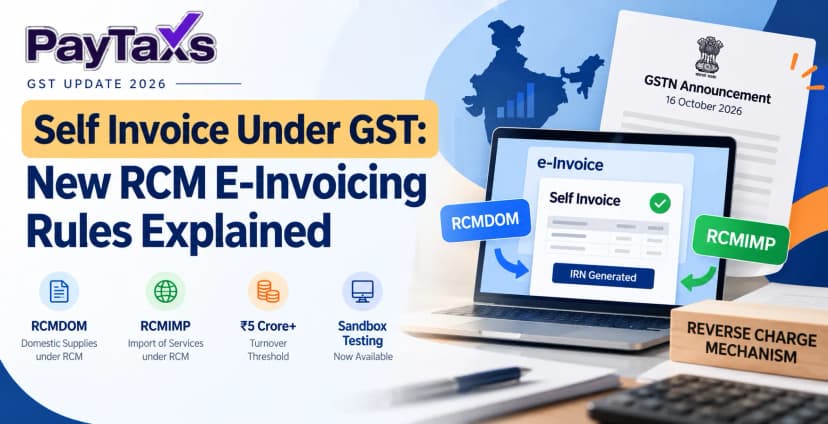
Self Invoice Under GST: New RCM E-Invoicing Rules ExplainedSelf Invoice Under GST: New RCM E-Invoicing Rules Explained
Written by Hatim Dudhiyawala

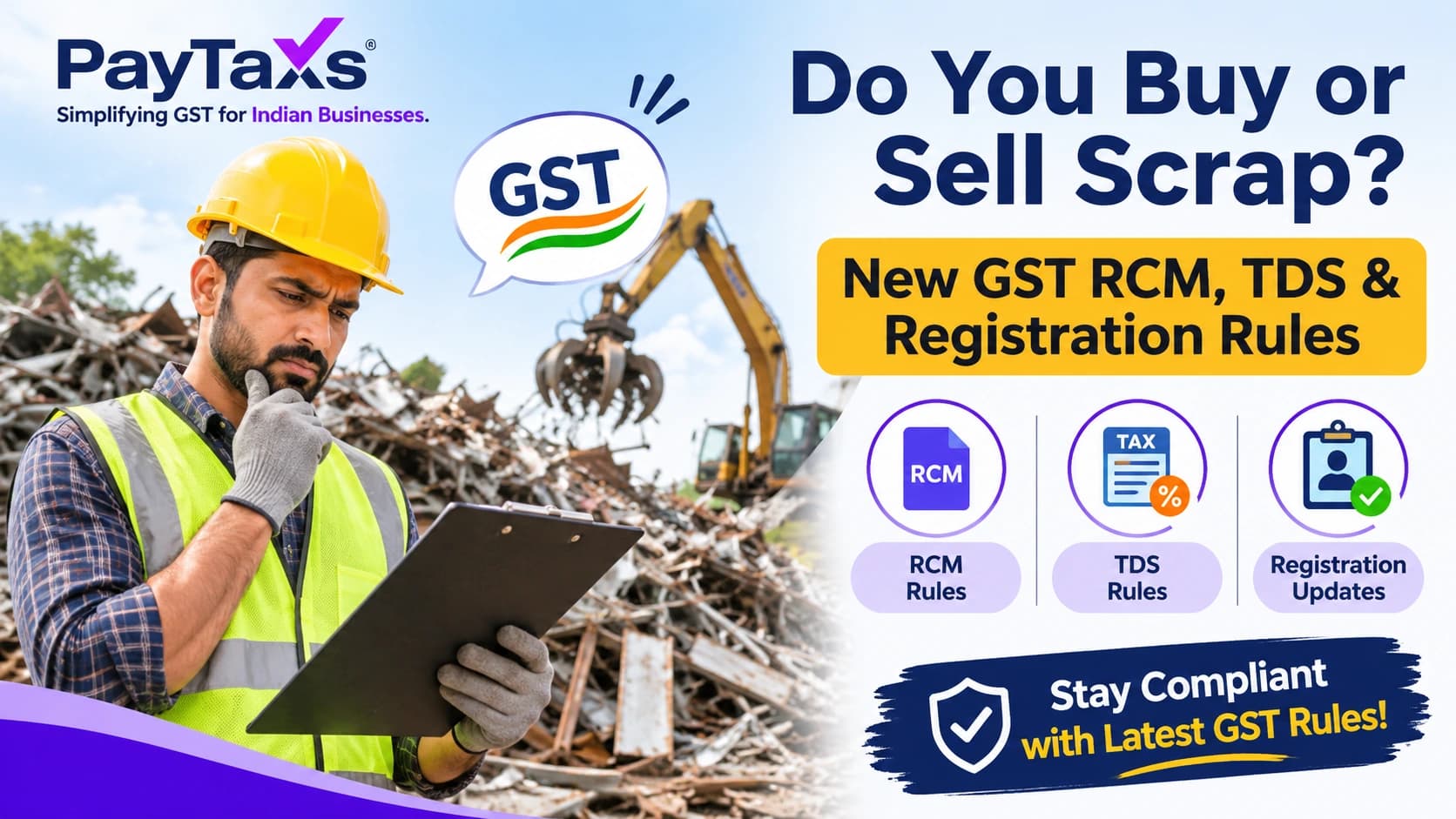
From 1 November 2026, GST rules changed in three ways for people who buy or sell scrap. This guide explains each change in simple words, with examples and a checklist. It was last updated on 2 November 2026.
Three things changed. The government issued the notifications on 27 October 2026, and all of them started on 1 November 2026.
Reverse charge (RCM): A registered buyer who buys used cooking oil, plastic scrap, tyre scrap or e-waste scrap from an unregistered seller now pays the GST directly to the government.
TDS: A registered buyer who buys any of five scrap goods from a registered seller must cut 2% TDS if the contract value is more than ₹2.5 lakh.
Registration: Scrap sellers no longer get a special exemption from GST registration. They must register once their turnover crosses the normal limit.
Metal scrap was already under these rules from October 2024. The new notifications bring four more goods into the same system.
|
Change |
Notification (all dated 27 October 2026) |
Who it affects |
Starts |
|
RCM on four more goods |
Registered buyers who buy from unregistered sellers |
1 Nov 2026 |
|
|
2% TDS on five goods |
No. 07/2026-Central Tax |
Registered buyers who buy from registered sellers |
" " " " " " " " " |
|
Registration exemption removed |
No. 06/2026-Central Tax |
Sellers of the five goods |
" " " " " " " " " |
Five scrap goods are covered. Scrap here means leftover or used material that is sold for recycling or reuse.
|
Goods |
Tariff heading |
What is new from 1 Nov 2026 |
|
Used cooking oil |
1518 |
RCM, TDS and registration rules are all new |
|
Waste and scrap of plastics |
3915 |
" " " " " " " " " |
|
Waste and scrap of tyres |
4004 |
" " " " " " " " " |
|
Electrical and electronic waste and scrap (e-waste) |
8549 |
" " " " " " " " " |
|
Metal scrap |
Chapters 72 to 81 |
Nothing new. These rules already applied from October 2024 |
RCM (reverse charge mechanism): The buyer pays the GST to the government. The seller does not charge GST.
TDS (tax deducted at source): The buyer keeps back a small part of the payment and deposits it with the government on the seller's behalf.
Registered person: A person who has a GST number (GSTIN).
Unregistered person: A person who has no GST number, such as many small kabadiwalas.
Self-invoice: An invoice that the buyer makes in their own books when the seller is unregistered and cannot issue a tax invoice.
Read More: Want to find the HSN code of a product
If you are a registered buyer and the seller is unregistered, you pay the GST on these goods yourself. Notification 04/2026 adds four goods to the reverse charge list: used cooking oil, plastic scrap, tyre scrap and e-waste scrap. The rule covers any supply from an unregistered person to a registered person. The notification sets no minimum value, so even a small purchase is covered.
The law behind it is Section 9(3) of the CGST Act, Section 5(3) of the IGST Act, and Section 7(3) of the UTGST Act. If the seller and buyer are in the same State, you pay CGST and SGST. If they are in different States, you pay IGST.
Check the seller's GST status on the GST portal. If the seller has a GSTIN, the normal rules apply, and RCM does not.
If the seller has no GSTIN, make a self-invoice for the purchase and keep the payment proof.
Pay the seller only the price of the goods. Do not pay the seller any GST.
Pay the GST to the government in cash through your GSTR-3B return. RCM tax cannot be paid from your input tax credit balance.
Claim the same amount as input tax credit in GSTR-3B, if the goods are used for your taxable business.
Tax becomes due on the earlier of two dates: the day you receive the goods or the day you pay for them.
An unregistered seller must not charge GST on these goods. The seller just sells at the agreed price. If the seller later becomes registered, the next section applies to them.
If you are a registered buyer and the seller is also registered, you must deduct 2% TDS when the contract value is more than ₹2.5 lakh. Notification 07/2026 changes clause (d) of Notification 50/2018-Central Tax. It now covers all five goods: used cooking oil, plastic scrap, tyre scrap, metal scrap, and e-waste scrap. Before this, only metal scrap was covered.
|
Point |
Rule |
|
Who deducts |
A registered buyer who buys the goods from a registered seller |
|
Rate |
2% of the taxable value, without GST. Within a State it is 1% CGST and 1% SGST. Between States it is 2% IGST |
|
Limit |
Total value of supply under one contract is more than ₹2.5 lakh |
|
Place of supply |
Under Section 51 of the CGST Act, no TDS is cut if the seller and the place of supply are in a different State from the buyer's registration State |
|
Buyer's registration |
The buyer needs a TDS registration on Form GST REG-07. A normal GSTIN alone is not enough |
|
Deposit and return |
Deposit the TDS and file Form GSTR-7 by the 10th of the next month |
Read More: Want to understand GST TDS in detail
GSTN issued an advisory on 1 November 2026 for this. The steps are:
Log in to the GST portal and file Form GST REG-07.
In Part B, Table 2, choose "Others" under Constitution of Business.
In the box that opens, write your category, for example, "Used Cooking Oil Dealers".
Fill the other fields and submit.
The seller does not lose this money. The amount you deposit goes to the seller's electronic cash ledger, and the seller can use it to pay GST. After you deposit it, give the seller a TDS certificate (Form GSTR-7A).
Scrap sellers must now take a GST number once their turnover crosses the normal limit. Earlier, a person whose supplies were all under reverse charge did not need registration at any turnover. This relief came from Notification 05/2017-Central Tax. Notification 06/2026 takes these five goods out of that relief. For metal scrap, this had already happened in October 2024.
Goods: ₹40 lakh in most States. Some States have a lower limit of ₹20 lakh, so check the limit for your State.
Services: ₹20 lakh.
What counts as turnover: All your sales of goods and services under the same PAN, not only scrap.
This does not mean every scrap seller must register. A seller below the limit can stay unregistered. When the turnover crosses the limit, the seller must apply for registration within 30 days under Section 25(1) of the CGST Act.
The seller charges GST and issues a tax invoice.
The buyer no longer pays under RCM for that seller's sales.
A registered buyer with TDS registration deducts 2% TDS if the contract is above ₹2.5 lakh.
The rule depends on whether the seller and the buyer are registered. Use this table to find your case.
|
Seller |
Buyer |
What happens |
|
Unregistered |
Registered |
RCM. The buyer pays the GST. No TDS |
|
Registered |
Registered (with TDS registration), contract above ₹2.5 lakh |
The seller charges GST. The buyer cuts 2% TDS |
|
Registered |
Registered, contract ₹2.5 lakh or less |
The seller charges GST. No TDS, no RCM |
|
Registered |
Unregistered |
" " " " " " " " " |
|
Unregistered |
Unregistered |
No RCM and no TDS. The seller must register when turnover crosses the limit |
RCM and TDS never apply to the same sale. RCM is for unregistered sellers. TDS is for registered sellers.
These examples use a GST rate of 18% only to keep the sums easy. Use the rate that applies to your goods.
Example 1: RCM. Ramesh is an unregistered kabadiwala. He sells plastic scrap worth ₹1,20,000 to a registered recycling company in the same State.
The company pays Ramesh ₹1,20,000 only.
The company pays GST of ₹21,600 to the government in cash (₹10,800 CGST and ₹10,800 SGST).
The company claims ₹21,600 as input tax credit, if it uses the scrap for taxable sales.
Read More:
Example 2: TDS. A registered dealer sells e-waste scrap worth ₹4,00,000 to a registered buyer in the same State. The contract is above ₹2.5 lakh.
Invoice value: ₹4,00,000 plus 18% GST of ₹72,000, which is ₹4,72,000.
TDS is 2% of ₹4,00,000, which is ₹8,000 (₹4,000 CGST and ₹4,000 SGST).
The buyer pays the dealer ₹4,64,000 and deposits ₹8,000 with the government by the 10th of next month.
Example 3: No TDS. A registered seller sells used cooking oil worth ₹2,00,000 to a registered buyer. The contract is below ₹2.5 lakh, so there is no TDS. The seller charges normal GST.
Example 4: Registration. A scrap trader in a State with a ₹40 lakh limit sells only scrap. Their yearly turnover reaches ₹55 lakh. They must apply for GST registration within 30 days of crossing ₹40 lakh.
Check whether each seller has a GSTIN before you pay.
For unregistered sellers of the four new goods, make a self-invoice and pay GST under RCM.
For registered sellers, check if the contract is above ₹2.5 lakh. If yes, deduct 2% TDS.
Apply for TDS registration on Form GST REG-07 before you deduct.
Deposit TDS and file GSTR-7 by the 10th of the next month.
Keep invoices, payment proof and TDS certificates for your records.
Add up your yearly turnover from all goods and services under your PAN.
Apply for registration within 30 days after you cross the limit for your State.
After registration, issue a tax invoice and charge GST.
Check the TDS amounts that buyers deposit against your name, and use them to pay your GST.
Paying GST to an unregistered seller. Under RCM, the buyer pays it to the government.
Cutting TDS on the invoice value with GST. TDS is on the value without GST.
Paying RCM tax from the credit balance. It must be paid in cash.
Cutting TDS without a REG-07 registration.
Thinking a small scrap seller must register at any turnover. The normal limit still applies.
This guide is based on the CBIC notifications dated 27 October 2026 (Notification Nos. 04/2026-Central Tax (Rate), 06/2026-Central Tax, and 07/2026-Central Tax) and the GSTN advisory dated 1 November 2026. Before taking any action, please refer to the full details available on the CBIC website (cbic-gst.gov.in) and the GST portal (gst.gov.in).
Note: This guide is for information purposes only. The views expressed in this guide are personal and do not constitute the views of Paytaxs. Paytaxs or the author will not be responsible for any direct or indirect loss incurred by the reader for taking any decision based on the information or the contents. It is advisable to consult either a CA, CS, CPA or a professional tax expert from the Paytaxs team, as they are familiar with the current regulations and help you make accurate decisions and maintain accuracy throughout the whole process.
Hatim Dudhiyawala is a Certified Public Accountant (CPA) with Paytaxs and specializes in Indian and NRI taxation, including GST. He advises individuals, NRIs, and businesses on income tax filing, capital gains taxation, DTAA benefits, fund repatriation, GST compliance, and tax compliance. With experience in cross-border tax matters, Hatim helps taxpayers understand complex regulations and make informed decisions. Through his articles on GST updates, notifications, and compliance, he shares practical insights to help readers stay compliant and manage their tax obligations with confidence. See Full Bio
Want to read more? Explore Blogs