

GST Codes & Classifications
What Is GST State Code? Complete List for All States (2026-27)What Is GST State Code? Complete List for All States (2026-27)
Written by Hatim Dudhiyawala

Every product sold in India has a classification that helps businesses identify it under the GST system. This classification is called the Harmonized System of Nomenclature (HSN) code. It helps businesses report goods correctly, prepare GST invoices and determine the applicable tax rate.
However, finding the correct code is not always easy. Two products that look similar may have different HSN classifications or GST rates because of their material, composition, use or other specifications.
This guide provides a category-wise HSN code list with GST rate for commonly traded non-grocery products, including electronics, clothing, machinery, jewellery, medicines, construction materials and household goods. It also explains how to search for the correct code and verify its applicable GST rate through official government sources.
Note: Grocery products are not covered in these tables. For grocery-related classifications, read our separate guide on grocery HSN codes with GST rates.
HSN stands for Harmonized System of Nomenclature. It is an internationally recognised system used to classify goods based on their nature, composition and characteristics.
Under GST in India, HSN codes help businesses identify the correct category of goods when preparing tax invoices and reporting sales in GST returns.
For example, a mobile phone, a cotton shirt and a piece of machinery belong to different product classifications. Each has its own HSN heading or tariff item.
An HSN code generally follows this structure:
|
Digits |
Classification level |
|
First 2 digits |
Chapter |
|
First 4 digits |
Heading |
|
First 6 digits |
Subheading |
|
8 digits |
Indian tariff item |
For example, heading 8517 covers certain telephone sets, including smartphones, and other communication equipment. The precise tariff item depends on the product description.
If you want to understand the classification system in more detail, read our guide on what an HSN code means and how it is structured.
Different industries use different HSN classifications. The following tables cover commonly traded non-grocery products and provide a starting point for identifying their classifications and applicable GST rates.
The rates below are general reference rates based on the CBIC GST rate schedules available at the time of preparation. Always verify the exact tariff item and applicable conditions before using a code on an invoice.
Textile products are classified according to their material, manufacturing process and product type. Cotton fabrics, synthetic fabrics, knitted garments and non-knitted garments may fall under different HSN headings.
|
Product |
HSN heading |
General GST rate |
|
Silk fabrics |
5007 |
5% |
|
Cotton fabrics |
5208, 5209 |
5% |
|
Synthetic filament fabrics |
5407, 5408 |
5% |
|
Knitted fabrics |
60 |
5% |
|
Knitted garments |
61 |
5% or 12% |
|
Non-knitted garments |
62 |
5% or 12% |
|
Made-up textile articles |
63 |
5% or 12%, depending on entry |
Important: Apparel rates can depend on the sale value per piece. For example, specified apparel priced up to ₹1,000 per piece is generally covered under the 5% rate, while specified apparel above ₹1,000 per piece is generally covered under the 12% rate.
Electronic goods are classified according to their function, technical specifications and components. Businesses selling electronic equipment should check the exact product description instead of relying only on its common name.
|
Product |
HSN heading |
General GST rate |
|
Telephone sets and mobile phones |
8517 |
18% |
|
Computers and laptops |
8471 |
18% |
|
Television receivers |
8528 |
18% |
|
Electrical transformers |
8504 |
18% |
|
Electric motors |
8501 |
18% |
|
Electric accumulators and batteries |
8507 |
18% |
|
Electrical cables and insulated wires |
8544 |
18% |
Machinery classifications depend on the purpose, operating mechanism and technical specifications of the equipment.
|
Product |
HSN heading |
General GST rate |
|
Air or vacuum pumps |
8414 |
18% |
|
Liquid pumps |
8413 |
18% |
|
Air conditioning machines |
8415 |
18% |
|
Refrigerators and freezers |
8418 |
18% |
|
Water filters and purifiers |
8421 |
18% |
|
Lifting and handling machinery |
8428 |
18% |
|
Agricultural machinery |
8432 |
Check exact entry |
|
Industrial machinery |
8479 |
18% for specified entries |
Read More: E-Invoicing for RCM From 1 January 2027
Vehicles and their components are classified according to vehicle type, construction and intended use. Some automobile categories also have additional compensation cess or special tax treatment.
|
Product |
HSN heading |
GST rate |
|
Motor cars and other motor vehicles |
8703 |
Varies |
|
Motorcycles and scooters |
8711 |
Varies |
|
Motor vehicle parts |
8708 |
Generally 18% |
|
Tyres |
4011 |
18% |
|
Vehicle batteries |
8507 |
18% |
|
Bicycles |
8712 |
Check exact entry |
Do not assume that all vehicles attract the same rate. Engine capacity, vehicle type, specifications and applicable cess provisions can affect the final tax treatment.
Construction businesses deal with a wide range of materials, including cement, steel, tiles, marble, glass and sanitary fittings.
|
Product |
HSN heading |
General GST rate |
|
Cement |
2523 |
18% |
|
Marble and travertine, specified forms |
2515 |
18% |
|
Granite, specified forms |
2516 |
18% |
|
Iron and steel bars and rods |
7214 |
18% |
|
Ceramic tiles |
6907 |
18% |
|
Glass and glass products |
70 |
Depends on product |
|
Structures of iron or steel |
7308 |
18% |
|
Structures of aluminium |
7610 |
18% |
|
Sanitary fittings |
6910 |
18% |
Medicines and medical equipment have different classifications depending on their ingredients, intended use, composition and technical characteristics.
|
Product |
HSN heading |
GST rate |
|
Pharmaceutical medicaments |
3004 |
5% or 18%, depending on entry |
|
Vaccines |
3002 |
Depends on classification |
|
Medical instruments and appliances |
9018 |
Generally 18% |
|
Orthopaedic appliances |
9021 |
Generally 5% or 18%, depending on entry |
|
Diagnostic equipment |
9022 |
Generally 18% |
Certain medicines and medical products receive concessional rates or exemptions. Always check the exact description in the applicable schedule.
Cosmetics and personal care products are generally classified based on their ingredients, intended use and form.
|
Product |
HSN heading |
General GST rate |
|
Perfumes and toilet waters |
3303 |
18% |
|
Beauty and skincare preparations |
3304 |
18% |
|
Hair preparations and shampoos |
3305 |
18% |
|
Oral and dental hygiene preparations |
3306 |
18% |
|
Shaving and deodorising preparations |
3307 |
18% |
|
Soap and organic surface-active products |
3401 |
Generally 18%, subject to entry |
Jewellery classifications depend on the material used, whether the item contains precious stones and whether it is made from precious or imitation materials.
|
Product |
HSN heading |
GST rate |
|
Silver |
7106 |
3% |
|
Gold |
7108 |
3% |
|
Diamonds |
7102 |
Depends on form and classification |
|
Precious and semi-precious stones |
7103 |
Depends on classification |
|
Articles of jewellery |
7113 |
3% |
|
Goldsmiths' and silversmiths' wares |
7114 |
3% |
|
Imitation jewellery |
7117 |
3% |
The GST rate on jewellery articles should not be confused with the GST treatment of jewellery-making or job-work services, which have separate service classifications and applicable rates.
Furniture and household products are classified according to the material, construction and intended use of the item.
|
Product |
HSN heading |
General GST rate |
|
Wooden furniture |
9403 |
18% |
|
Metal furniture |
9403 |
18% |
|
Plastic furniture |
9403 |
18% |
|
Mattresses |
9404 |
18% |
|
Lamps and lighting fittings |
9405 |
18% |
|
Ceramic household articles |
6912 |
18% |
|
Plastic household products |
3924 |
18% |
Chemical products are classified according to their chemical composition, physical form and intended application. Similar-looking products may have different classifications.
|
Product |
HSN heading |
General GST rate |
|
Organic chemicals |
Chapter 29 |
Varies |
|
Pharmaceutical and chemical preparations |
Chapter 30 |
Varies |
|
Essential oils and cosmetic raw materials |
3301 |
Generally 18% |
|
Soap and surface-active products |
3401, 3402 |
Generally 18% |
|
Plastic packaging articles |
3923 |
Generally 18% |
|
Plastic household articles |
3924 |
Generally 18% |
|
New pneumatic rubber tyres |
4011 |
18% |
|
Other rubber articles |
4016 |
Generally 18% |
Paper products, printed materials and stationery are classified according to their composition, manufacturing process and intended use.
|
Product |
HSN heading |
General GST rate |
|
Uncoated paper and paperboard |
4802 |
Generally 18% |
|
Coated paper and paperboard |
4810 |
Generally 18% |
|
Cartons, boxes and cases of paper or paperboard |
4819 |
Generally 18% |
|
Printed books |
4901 |
Nil |
|
Newspapers and periodicals |
4902 |
Nil |
|
Printed advertising material |
4911 |
Generally 18% |
|
Exercise books |
4820 |
Generally 18% |
Sports equipment, toys and recreational products have different HSN classifications based on their construction, material and intended purpose.
|
Product |
HSN heading |
General GST rate |
|
Tricycles, scooters and similar toys |
9503 |
5% or 18%, depending on product |
|
Video game consoles |
9504 |
Generally 18% |
|
Sports equipment |
9506 |
Generally 18% |
|
Musical instruments |
92 |
Depends on product |
|
Watches |
9101, 9102 |
Generally 18% |
|
Umbrellas |
6601 |
Generally 18% |
|
Footwear |
64 |
5% or 18%, depending on applicable entry |
Rate verification: The above tables are a practical starting point, not a substitute for the full CBIC tariff descriptions. Where a rate is shown as variable, the exact product entry must be checked before invoicing. The official schedules and notifications take precedence over this summary.
Before using a product classification, it is important to understand how GST is divided between the Central and State Governments.
GST rates on goods are specified through applicable rate notifications. For an intra-state supply, CGST and SGST generally apply together. For an inter-state supply, IGST generally applies.
For example:
|
Total GST rate |
CGST |
SGST |
IGST |
|
5% |
2.5% |
2.5% |
5% |
|
18% |
9% |
9% |
18% |
|
40% |
20% |
20% |
40% |
The applicable rate depends on the product classification and the relevant notification. Some products also have exemptions or special conditions.
To understand the individual components, read our guides on CGST, SGST and IGST.
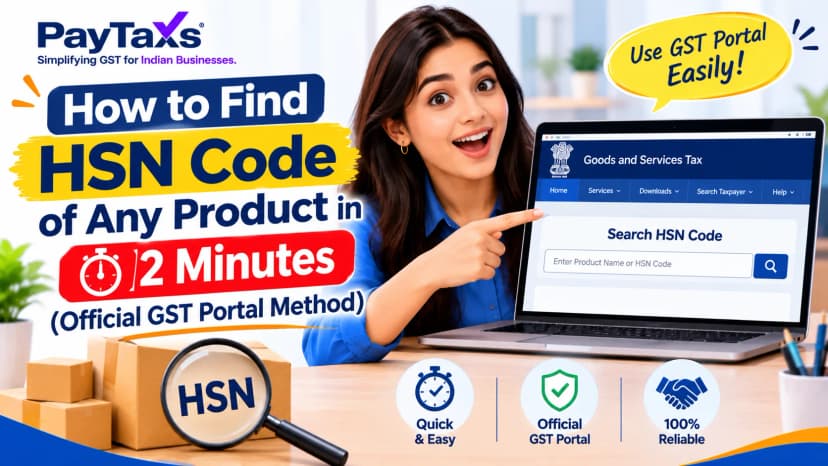
You can check the applicable tax rate by searching for a product's HSN code on the official GST Portal.
Follow these steps:
Visit the GST Portal.
Open Services and select User Services.
Click on Search HSN Code.
Enter the product name, description or HSN code.
Review the matching product description and classification.
Check the displayed tax-rate information.
Verify the classification against the applicable CBIC rate notification.
The GST Portal allows users to search for HSN codes and descriptions in both pre-login and post-login modes. It also provides an option to download the HSN directory in Excel format.
You can use the official GST Portal HSN/SAC search guide for detailed instructions.
For a complete step-by-step explanation, read our existing guide on how to find HSN code of any product.
The number of HSN digits required on a GST invoice generally depends on the business's aggregate turnover in the preceding financial year.
|
Aggregate turnover |
HSN digits generally required |
|
Up to ₹5 crore |
4 digits |
|
More than ₹5 crore |
6 digits |
There is an exception for registered persons with aggregate turnover up to ₹5 crore. They may not be required to mention the prescribed HSN digits on tax invoices issued for supplies to unregistered persons.
These requirements are based on Notification No. 78/2020-Central Tax, effective from 1 April 2021. Check the applicable notification and any subsequent amendments before issuing invoices.
Read the official notification on HSN reporting requirements.
HSN and SAC codes are both classification systems used under GST, but they apply to different types of supplies.
|
Basis |
HSN Code |
SAC Code |
|
Full form |
Harmonized System of Nomenclature |
Services Accounting Code |
|
Used for |
Goods |
Services |
|
Purpose |
Classifies physical products |
Classifies services |
|
Examples |
Mobile phones, clothing, machinery |
Consulting, transportation, professional services |
For example, a business selling mobile phones uses the relevant HSN classification for those products. A business providing consulting services uses the applicable SAC classification.
If your business supplies both goods and services, the relevant HSN and SAC details may both be required on invoices.
Choosing an incorrect classification can create problems in GST invoicing, return reporting and tax calculations.
Here are some common mistakes businesses should avoid:
Selecting a code based only on the product name: Similar products can have different classifications depending on their composition, material and intended use.
Copying codes from old lists: GST rates and tariff descriptions may change through government notifications.
Ignoring product specifications: A product's material, size, manufacturing process or intended application can affect classification.
Using an incorrect number of digits: Businesses must follow the applicable HSN reporting requirements.
Applying the same rate to every product under a heading: A single heading may contain several product-specific entries.
Not reviewing invoices: Incorrect product classifications or tax rates can create reporting discrepancies.
Get expert assistance with HSN classification, GST rates, invoicing and GST filing.
Let Paytaxs simplify your GST compliance.
Businesses should regularly review their invoices and GST records to identify classification and tax mismatches. Read our guide on GST reconciliation and common mismatches to understand how these issues can be identified and addressed.
Selecting the correct product classification is an important part of managing GST compliance. Businesses should not rely only on product names or previously used codes because the applicable classification and tax rate may depend on specific product details.
This HSN code list with GST rate provides a starting point for identifying commonly used product classifications across different industries. However, the final rate should always be verified against the applicable government notification and the exact product description.
If you are unsure about product classification, invoice reporting or applicable GST rates, professional guidance can help you avoid unnecessary compliance errors.
Explore Paytaxs GST services for support with GST advisory, invoicing, reconciliation and compliance requirements. You can also contact our team to discuss your business requirements.
Disclaimer: This article is intended for general educational purposes. GST rates and HSN classifications may change through notifications and amendments. Verify the applicable rate for the exact product and transaction date before issuing a tax invoice.
Note: This guide is for information purposes only. The views expressed in this guide are personal and do not constitute the views of Paytaxs. Paytaxs or the author will not be responsible for any direct or indirect loss incurred by the reader for taking any decision based on the information or the contents. It is advisable to consult either a CA, CS, CPA or a professional tax expert from the Paytaxs team, as they are familiar with the current regulations and help you make accurate decisions and maintain accuracy throughout the whole process.
Hatim Dudhiyawala is a Certified Public Accountant (CPA) with Paytaxs and specializes in Indian and NRI taxation, including GST. He advises individuals, NRIs, and businesses on income tax filing, capital gains taxation, DTAA benefits, fund repatriation, GST compliance, and tax compliance. With experience in cross-border tax matters, Hatim helps taxpayers understand complex regulations and make informed decisions. Through his articles on GST updates, notifications, and compliance, he shares practical insights to help readers stay compliant and manage their tax obligations with confidence. See Full Bio
Want to read more? Explore Blogs