

GST Codes & Classifications
HSN Code List with GST Rate in India (2026): Complete Category-Wise GuideHSN Code List with GST Rate in India (2026): Complete Category-Wise Guide
Written by Hatim Dudhiyawala

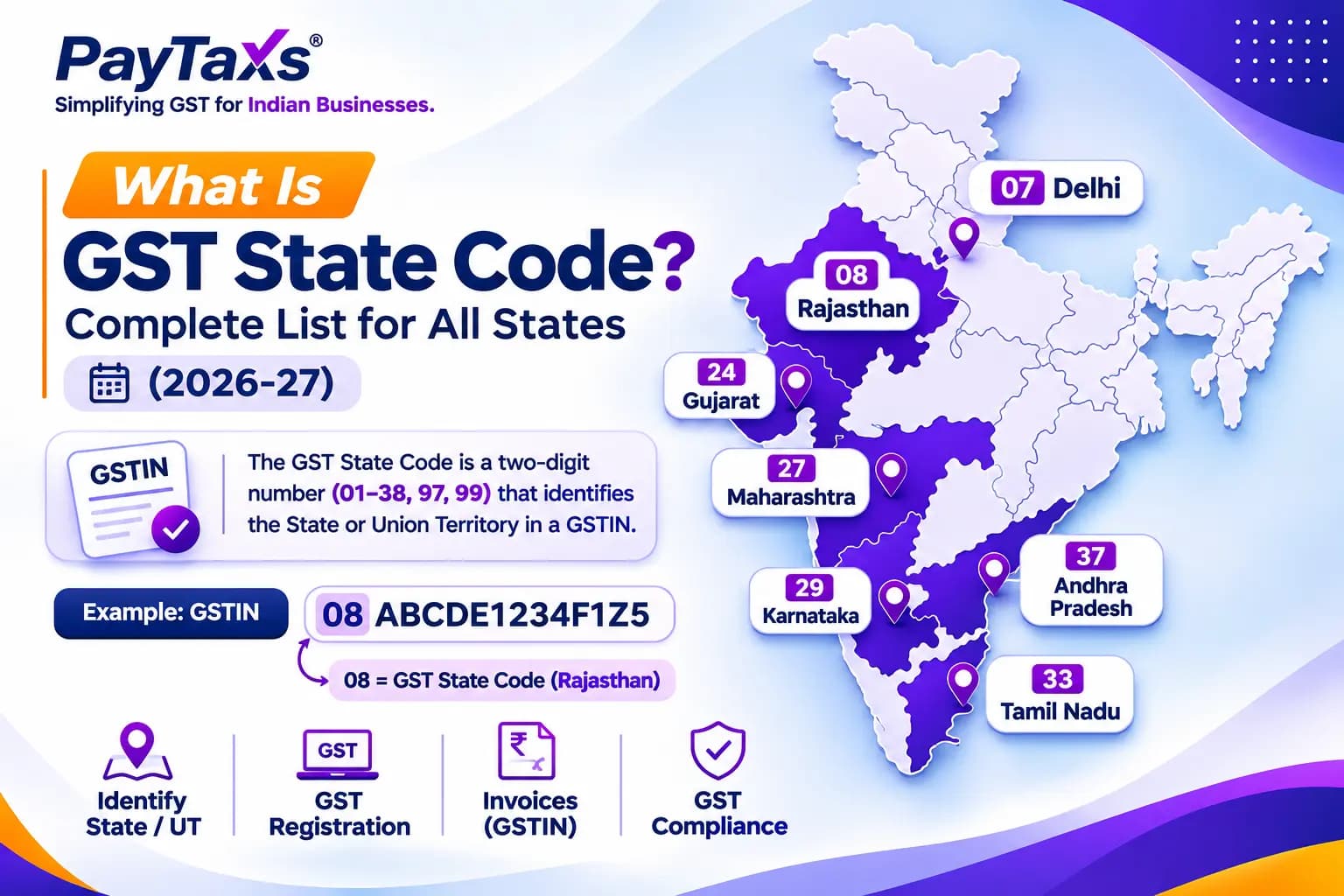
Look at the GST number on any GST invoice. The first two digits represent the state code. In short, the GST state code indicates the state or union territory in which a business is registered. For example, '08' stands for Rajasthan, '27' for Maharashtra, and '06' for Haryana. Every state and union territory has its own unique code, which is useful when generating invoices, filing returns, or verifying a supplier.
Below is the complete list of GST state codes. Additionally, some of the most frequently searched codes—such as 27, 08, 33, 36, 19, 29, and the code for Haryana—are explained separately. The full list of GST state codes is provided below.
Every state and union territory in India has its own two-digit number under GST. That number is the GST state code. You will see it as the first two digits of any GST number. The code is not something a business picks. It comes from the state where the GST registration is taken. If you register in Gujarat, your GSTIN starts with 24. If you register in Kerala, it starts with 32.
You need this code in a few places: on your GSTIN, on tax invoices, on e-way bills, and while filing GSTR-1 and GSTR-3B. Even the GST portal uses it to know which state your sale belongs to. If you ever look at a bill and wonder where the seller is from, check the first two digits of the GST number. That is usually enough.
Here is the complete list of state codes. The table is in code order, so it is easy to find any state.
|
Sr. No. |
GST State Code |
State / Union Territory |
Type |
|
1 |
01 |
Jammu and Kashmir |
Union Territory |
|
2 |
02 |
Himachal Pradesh |
State |
|
3 |
03 |
Punjab |
State |
|
4 |
04 |
Chandigarh |
Union Territory |
|
5 |
05 |
Uttarakhand |
State |
|
6 |
06 |
Haryana |
State |
|
7 |
07 |
Delhi |
Union Territory |
|
8 |
08 |
Rajasthan |
State |
|
9 |
09 |
Uttar Pradesh |
State |
|
10 |
10 |
Bihar |
State |
|
11 |
11 |
Sikkim |
State |
|
12 |
12 |
Arunachal Pradesh |
State |
|
13 |
13 |
Nagaland |
State |
|
14 |
14 |
Manipur |
State |
|
15 |
15 |
Mizoram |
State |
|
16 |
16 |
Tripura |
State |
|
17 |
17 |
Meghalaya |
State |
|
18 |
18 |
Assam |
State |
|
19 |
19 |
West Bengal |
State |
|
20 |
20 |
Jharkhand |
State |
|
21 |
21 |
Odisha |
State |
|
22 |
22 |
Chhattisgarh |
State |
|
23 |
23 |
Madhya Pradesh |
State |
|
24 |
24 |
Gujarat |
State |
|
25 |
26 |
Dadra and Nagar Haveli and Daman and Diu |
Union Territory |
|
26 |
27 |
Maharashtra |
State |
|
27 |
29 |
Karnataka |
State |
|
28 |
30 |
Goa |
State |
|
29 |
31 |
Lakshadweep |
Union Territory |
|
30 |
32 |
Kerala |
State |
|
31 |
33 |
Tamil Nadu |
State |
|
32 |
34 |
Puducherry |
Union Territory |
|
33 |
35 |
Andaman and Nicobar Islands |
Union Territory |
|
34 |
36 |
Telangana |
State |
|
35 |
37 |
Andhra Pradesh |
State |
|
36 |
38 |
Ladakh |
Union Territory |
|
37 |
97 |
Other Territory |
Special Code |
|
38 |
99 |
Centre Jurisdiction |
Special Code |
Get expert assistance with HSN classification, GST rates, invoicing and GST filing.
Let Paytaxs simplify your GST compliance.
A few things in this table can confuse people. Codes 25 and 28 are missing. Daman and Diu used to have code 25, but it was merged with Dadra and Nagar Haveli in 2020, and the merged territory now uses 26. Code 28 belonged to old Andhra Pradesh. After Telangana was formed, Andhra Pradesh got 37. Code 97 is for Other Territory. It is used for places that do not fall under any state, like some offshore areas. Code 99 is for Centre Jurisdiction and is used for central tax matters. Since new codes or changes can happen, check any code once on the official GST portal before using it in a document.
These are the state codes people search for the most.
Maharashtra's GST state code is 27. Any GSTIN starting with 27 is registered in Maharashtra, whether it is a business in Mumbai, Pune, or Nagpur.
Rajasthan has the state code 08. So a GST number like 08XXXXX... belongs to a Rajasthan registration. Traders in Jaipur, Jodhpur, Udaipur, and Kota all use this code.
Tamil Nadu uses 33. Chennai, Coimbatore, and Tiruppur businesses all have GST numbers that start with 33.
The state code for Telangana is 36. This is a newer code. It came after Telangana became a separate state, so some older lists and software may still show Telangana under Andhra Pradesh by mistake.
West Bengal has the code 19. Kolkata and the rest of the state follow it.
Karnataka is 29. Bengaluru has a huge number of GST registrations, and every one of them starts with 29.
People search both "Haryana GST code" and "Haryana GST state code". The answer is the same: 06. A GSTIN that starts with 06 is registered in Haryana, such as in Gurugram, Faridabad, or Panipat. A sample Haryana GSTIN would look like this: 06ABCDE1234F1Z5. This is only an example, not a real number.
A GSTIN has 15 characters. Each part means something.
Take the sample number 08ABCDE1234F1Z5.
The first 2 digits (08) are the state code. This is Rajasthan.
The next 10 characters (ABCDE1234F) are the PAN of the business.
The 13th character (1) is the number of registrations that PAN has in that state. If the business takes a second registration in the same state, this becomes 2, and so on.
The 14th character is Z by default.
The 15th character (5) is a check digit. It is used by the system to catch typing mistakes.
A simple way to remember it: the first two are for the state, the next ten are for the PAN, and the last three are for the system. So if a supplier gives you a GST number, you can tell the state in a second. And since the PAN is right there, you can also see who owns it.
The state code decides which tax you charge.
When the seller and the place of supply are in the same state, the sale is intra-state. You charge CGST and SGST. For a union territory without its own legislature, it is CGST and UTGST. When they are in different states, the sale is inter-state, and you charge IGST.
Say a shop in Jaipur sells to a buyer in Jaipur. Both are in Rajasthan (08), so it is CGST plus SGST. If the same shop sells to a buyer in Ahmedabad (24), the sale is inter-state and IGST applies. The code also matters for the place of supply shown on the invoice, and for how the sale gets reported in your returns. If the state is wrong, the tax type usually goes wrong too.
You can check a GSTIN on the GST portal in a minute.
Go to the GST portal (gst.gov.in).
Click Services, then Search Taxpayer, then Search by GSTIN/UIN.
Type the GST number and the captcha.
The result shows the legal name, state, registration status and date of registration.
It is a good habit to do this before you buy from a new supplier, check if the GST number is active. If the GSTIN is cancelled or the state does not match what the supplier told you, it is better to find out before you take the invoice.
The registration certificate also shows the GSTIN, and the state is visible in the address on it.
People mix up a few codes that look similar.
The state code is the two-digit number at the start of GSTIN.
The jurisdiction code is different. It tells which ward, range, or division of the tax department handles your case within the state.
The PIN code is a six-digit postal code for your address. It has nothing to do with GST registration.
The HSN code is for goods, and the SAC code is for services. They indicate the tax rate of the item and have no link to the state.
Most state code problems come from small slips. The first one is putting the seller's state as the place of supply. The place of supply is where the goods or services are delivered or used, and it is not always the seller's own state. The second one is copying an old GST number from a previous invoice or contact sheet. If the supplier has since moved or taken a new registration, the old state code may no longer be correct.
The third one is typing the state code wrong in an e-way bill or in the billing software. A wrong digit can change the whole tax type. If that happens, you will have to correct your return, so try to fix it before the due date and not after it. It is worth looking at the first two digits of every GSTIN you enter, every time.
The GST state code is only two digits, but it shows up in a lot of places, from your GST number to your invoices and returns. Keep this list handy, and always check the first two digits of any GSTIN before you use it. If you are not sure about a registration, an invoice, or a tax type, a GST practitioner can sort it out quickly. Paytaxs helps small businesses and traders with GST registration, returns and notices.
Note: This guide is for information purposes only. The views expressed in this guide are personal and do not constitute the views of Paytaxs. Paytaxs or the author will not be responsible for any direct or indirect loss incurred by the reader for taking any decision based on the information or the contents. It is advisable to consult either a CA, CS, CPA or a professional tax expert from the Paytaxs team, as they are familiar with the current regulations and help you make accurate decisions and maintain accuracy throughout the whole process.
Hatim Dudhiyawala is a Certified Public Accountant (CPA) with Paytaxs and specializes in Indian and NRI taxation, including GST. He advises individuals, NRIs, and businesses on income tax filing, capital gains taxation, DTAA benefits, fund repatriation, GST compliance, and tax compliance. With experience in cross-border tax matters, Hatim helps taxpayers understand complex regulations and make informed decisions. Through his articles on GST updates, notifications, and compliance, he shares practical insights to help readers stay compliant and manage their tax obligations with confidence. See Full Bio
Want to read more? Explore Blogs