

GST Compliance & Updates
Composition Scheme in GST: Eligibility, Rates & BenefitsComposition Scheme in GST: Eligibility, Rates & Benefits
Written by Hatim Dudhiyawala

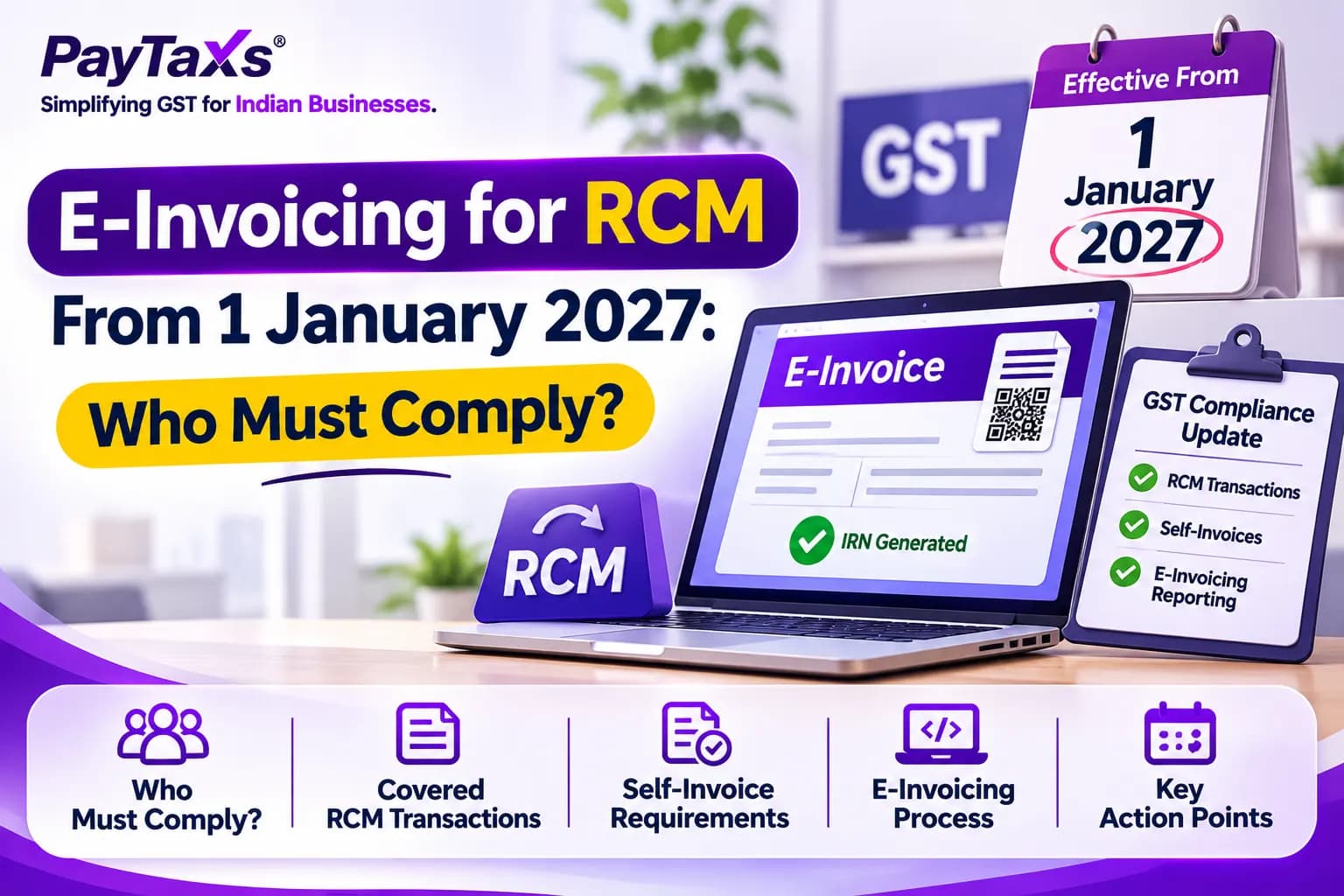
Think about the last time you paid an advocate, paid rent to a landlord who is not registered under GST, or bought software from a foreign company. In all three cases, you had to raise the invoice yourself and pay the GST under reverse charge.
Until now, that invoice stayed in your books, and nobody else saw it. From 1 January 2027, if you are already under e-invoicing, it will have to go through the IRP and get an IRN. So who exactly has to do this, and by when? Below, we cover who is covered, the dates, what can go wrong with your input tax credit, and a checklist to get ready.
From 1 January 2027, registered businesses already under e-invoicing (turnover above ₹5 crore) must generate an IRN for two more documents: the self-invoice on purchases from unregistered persons under RCM (RCMDOM) and the invoice on import of services (RCMIMP).
Until now, e-invoicing covered B2B supplies and exports. The invoices you raise as a buyer under reverse charge were left out. That is ending. Notification No. 04/2026-Central Tax, dated 26 October 2026, extends e-invoicing to these recipient-side documents from 1 January 2027.
Notification No. 05/2026-Central Tax, issued the same day, makes the matching changes in the CGST Rules and the e-invoice schema. GSTN followed this with an advisory on 17 November 2026. It confirms the dates and asks taxpayers, software providers, and other partners to finish their testing early.
It builds on an earlier advisory dated 16 October 2026, which introduced the two new supply types in the sandbox.
The rule is the same one that already decides who does e-invoicing. If your aggregate turnover crossed ₹5 crore in any financial year from 2017-18 onwards, you are in. There is no new turnover limit in 2026. The notification only adds two types of documents to the list. If you already generate IRNs for your sales, these two are now part of your job too. The import of goods is not covered. It is an import of services only.
The exclusions that currently exist will remain as they are. They include, for example, insurers, banking companies, financial institutions including NBFCs, goods transport agencies, passenger transport services, and SEZ units. Read Notification No. 13/2020-Central Tax, as amended, for the full list, and check where your own business stands.
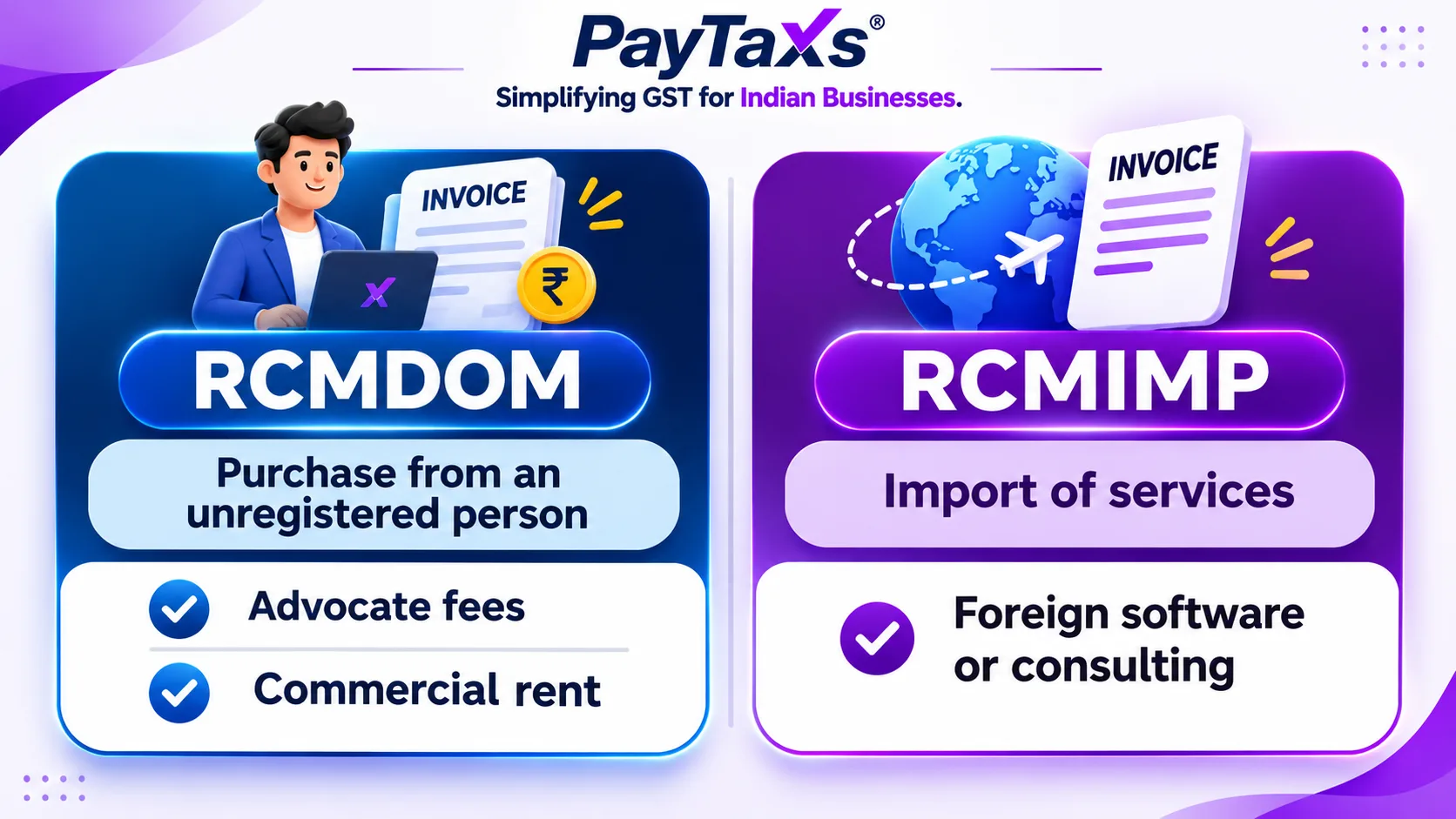
RCMDOM is the supply type for domestic RCM purchases from unregistered persons.
Here, the seller is not registered, so you cannot get a tax invoice from them. You raise a self-invoice yourself, pay the GST under reverse charge, and from 1 January 2027, you also report that self-invoice on the IRP and get an IRN. Two common examples are legal services from an advocate and rent for commercial property paid to an unregistered owner.
RCMIMP is the supply type for the import of services. When a foreign vendor provides you with a service, like software, design work, and consulting, the vendor is outside the GST system. You pay IGST under reverse charge and raise the invoice yourself. That invoice now needs an IRN too.
|
Point |
RCMDOM |
RCMIMP |
|
What it covers |
Domestic purchases from unregistered persons where you pay GST under RCM |
Import of services |
|
Who raises the invoice |
You, the recipient |
You, the recipient |
|
Example |
Advocate's fees, commercial rent from an unregistered owner |
Software or consulting from a foreign vendor |
|
Covered from |
1 January 2027 |
1 January 2027 |
|
Date |
What happens |
|
Now |
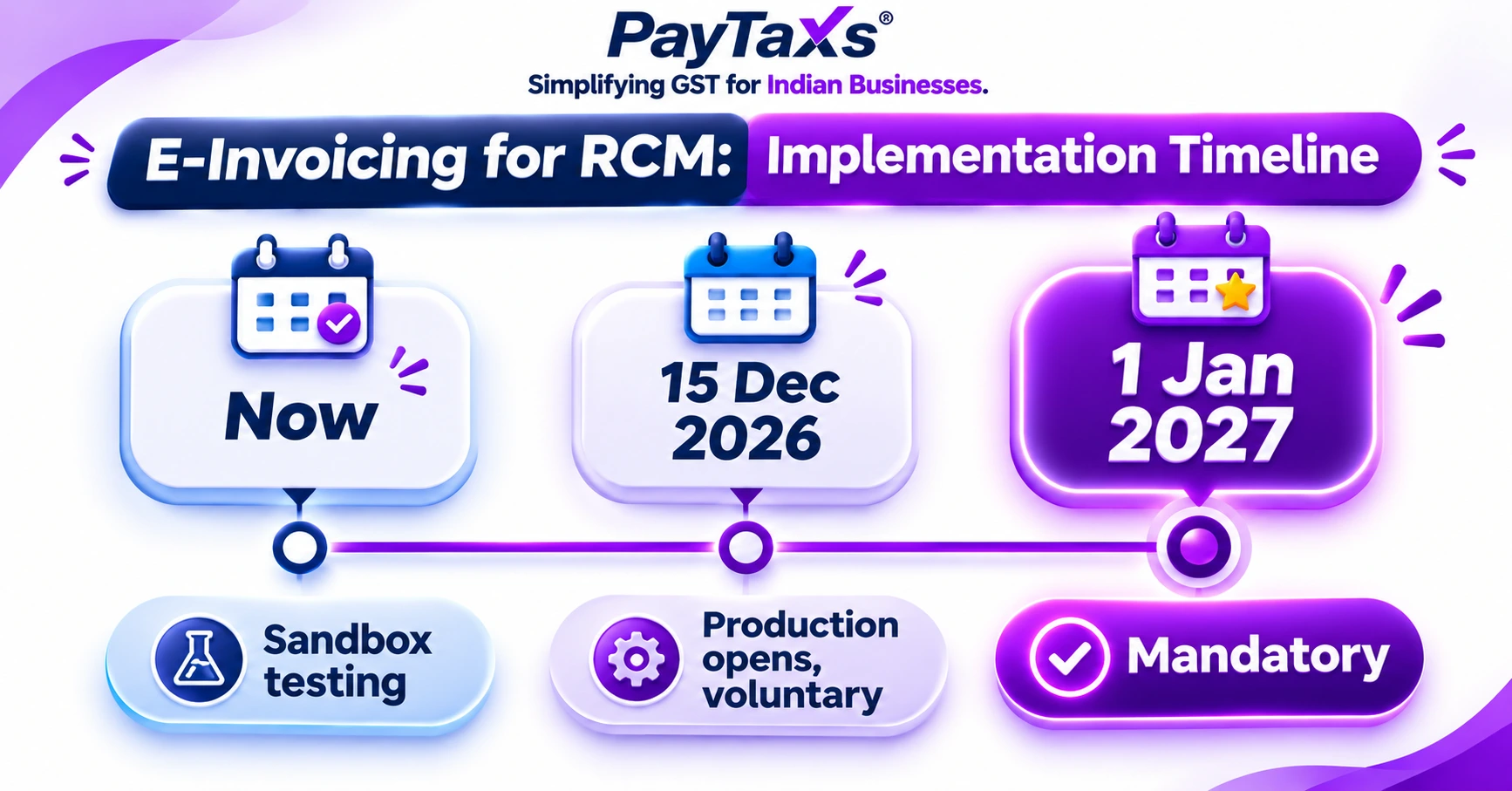
Sandbox testing is open on all six IRPs |
|
15 December 2026 |
IRPs open for RCMDOM and RCMIMP in production. Using it is your choice |
|
15 to 31 December 2026 |
You can generate IRNs if you want to, as a trial run |
|
1 January 2027 |
IRN becomes mandatory |
One thing to remember: the system accepts documents dated 15 December 2026 or later. Anything with an older date cannot be reported. Also, the sandbox is only for test data. Use the production system only for real purchases.
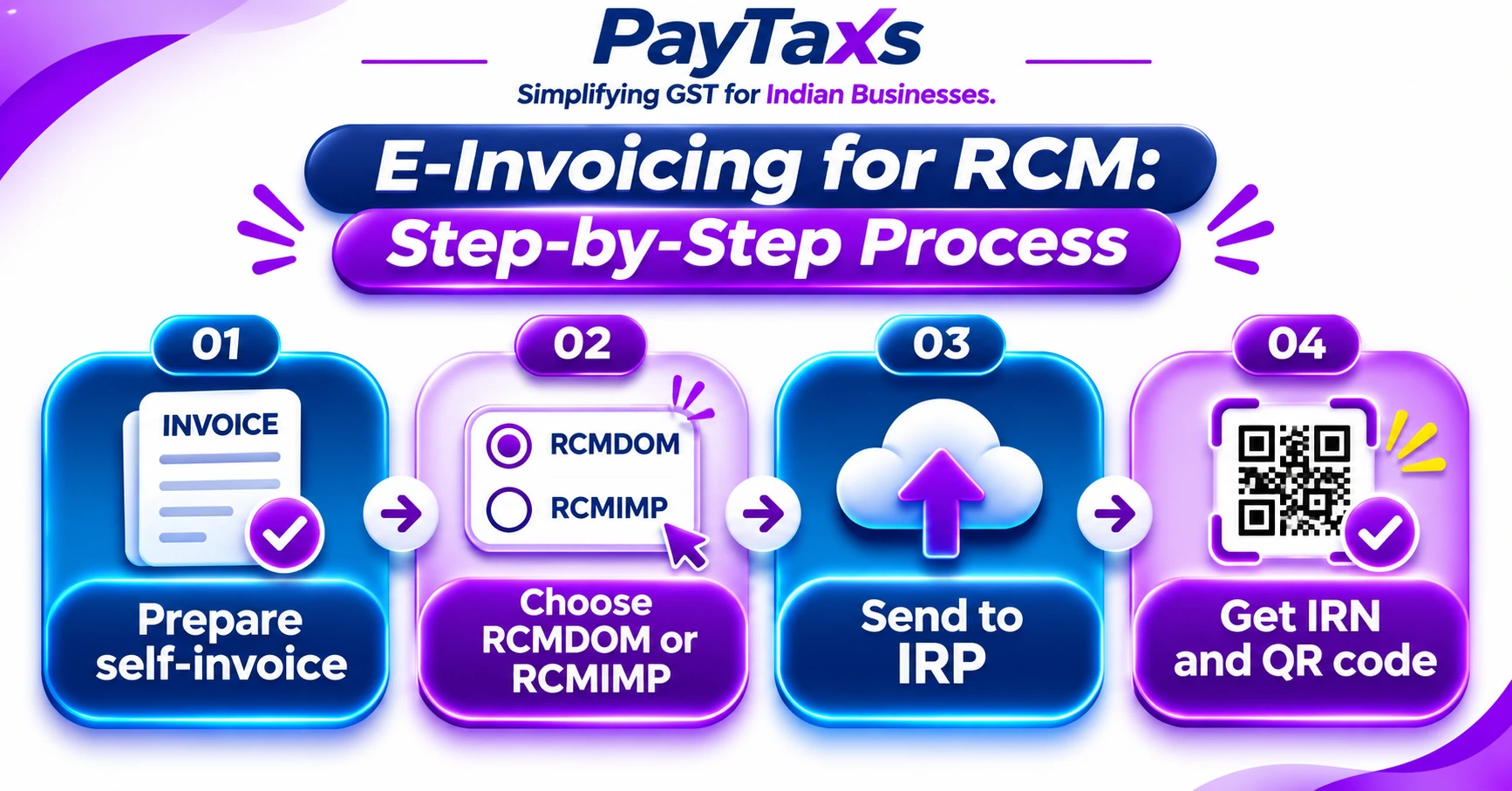
The steps are similar to what you already do for sales.
Prepare the self-invoice with the supplier's details, your GSTIN, the HSN or SAC code, value, and tax.
Pick the right supply type, RCMDOM or RCMIMP.
Send it through your billing software, ERP, and GSP to the IRP.
The IRP checks it and sends back the IRN and a QR code.
Keep the IRN on the invoice and record it in your books.
If you use a billing tool, check that it already supports the two new types before you start.
Two 30-day clocks matter here, and people mix them up.
The first is old. Rule 47A says a self-invoice must be issued within 30 days of receiving the goods or services.
The second is on the portal. If your turnover is ₹10 crore or more, the IRP does not accept an invoice that is more than 30 days old. GSTN has not yet said clearly whether this applies to RCMDOM and RCMIMP, so do not assume you are safe. The simple way to stay out of trouble is to raise the self-invoice and the IRN soon after the purchase, ideally within a week.
The biggest risk is your input tax credit.
Under Rule 48(5), where an e-invoice is required but is not generated, the document may not be treated as a valid invoice, for an RCM self-invoice, that puts the ITC on that purchase in danger. And since the tax is already paid in cash, losing the credit means a direct cost. Not issuing a valid invoice can also bring a penalty under GST law. Check Section 122 and your own position with your CA.
The sandbox for RCMDOM and RCMIMP is live on all six IRPs. The technical specifications, validations, and release notes are on the NIC e-Invoice API Developer Portal (einv-apisandbox.nic.in). Build and test now. Use sample data in the sandbox, and read the IRP-1 release notes before changing anything in production. The schema has changed under Notification No. 05/2026-Central Tax, so old payloads may fail.
What is clear is how the tax works today. You pay the RCM tax in cash in GSTR-3B, in Table 3.1(d), and then claim ITC in Table 4. What practitioners expect from 2027 is that the IRN data will show up in your GSTR-2B and in the IMS. GSTN has not yet published the full return mapping, so wait for its guidance before changing how you file.
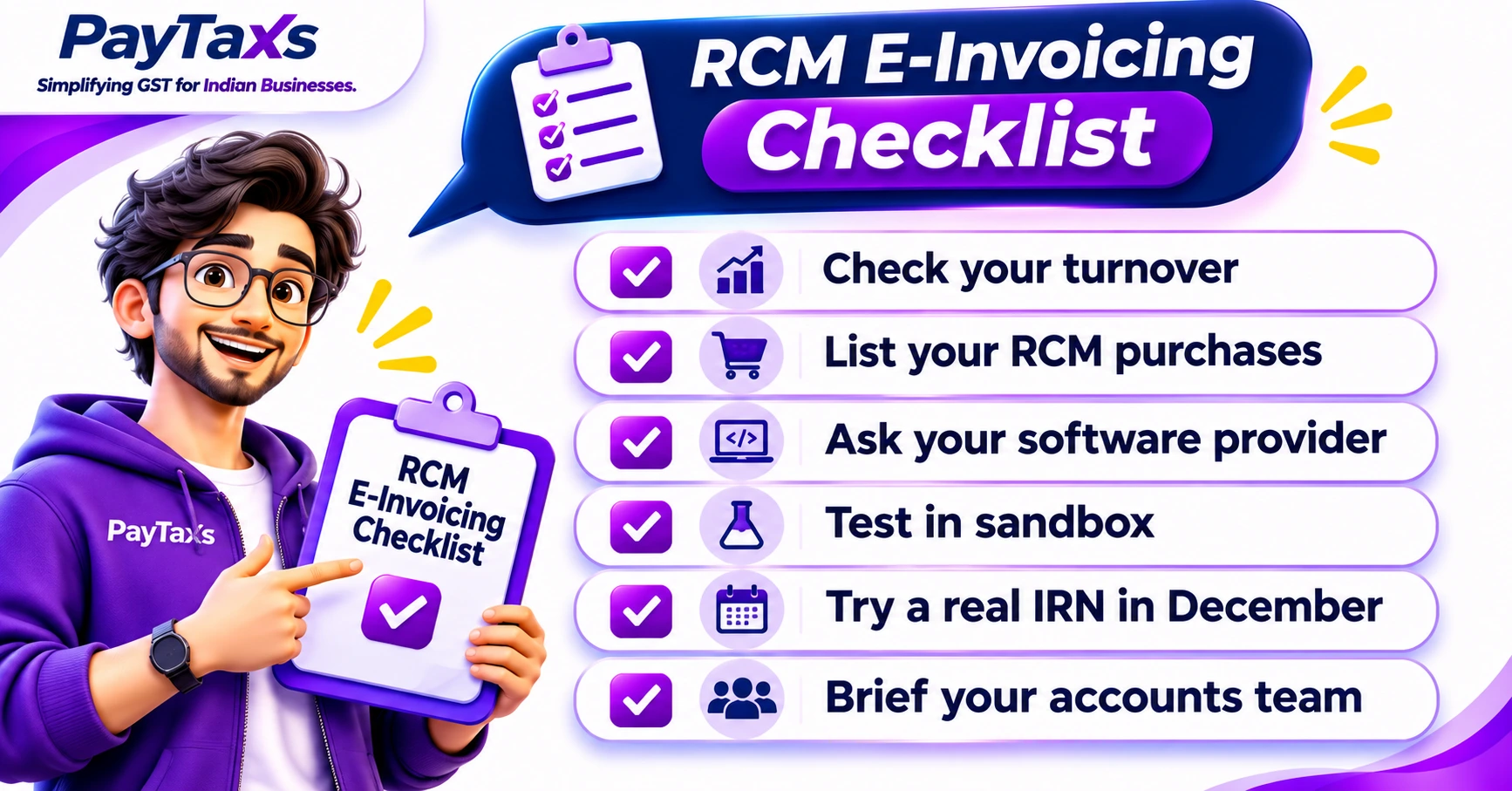
Check whether your turnover puts you under e-invoicing.
List all your RCM purchases: advocates, commercial rent, other unregistered suppliers, and imports of services.
Ask your billing or ERP provider whether RCMDOM and RCMIMP are ready.
Test in the sandbox with sample data.
Try a real IRN between 15 and 31 December on a genuine purchase.
Inform your accounts team about who creates self-invoices and by when they should be created.
The first mistake is treating the RCM self-invoice as a back-office paper. From 2027, it is an e-invoice, and it needs the same care as a sales invoice.
The second is testing with real transactions in production. Use the sandbox for tests.
The third is forgetting imports of services. Many businesses think about domestic RCM and miss the foreign vendor invoices that sit in a different folder.
The fourth is leaving it to January. By then, any problem with your software becomes a problem with your ITC.
This is not a new tax. It is a new way to report an invoice you already have to raise. But it comes with a deadline, and the cost of missing it is your input tax credit. Start with the sandbox now, run a trial in the last two weeks of December, and be ready for 1 January. If you are not sure whether you are covered, a GST practitioner can tell you in a short call. Paytaxs helps small and mid-size businesses with GST registration, returns, and compliance.
Note: This guide is for information purposes only. The views expressed in this guide are personal and do not constitute the views of Paytaxs. Paytaxs or the author will not be responsible for any direct or indirect loss incurred by the reader for taking any decision based on the information or the contents. It is advisable to consult either a CA, CS, CPA or a professional tax expert from the Paytaxs team, as they are familiar with the current regulations and help you make accurate decisions and maintain accuracy throughout the whole process.
Hatim Dudhiyawala is a Certified Public Accountant (CPA) with Paytaxs and specializes in Indian and NRI taxation, including GST. He advises individuals, NRIs, and businesses on income tax filing, capital gains taxation, DTAA benefits, fund repatriation, GST compliance, and tax compliance. With experience in cross-border tax matters, Hatim helps taxpayers understand complex regulations and make informed decisions. Through his articles on GST updates, notifications, and compliance, he shares practical insights to help readers stay compliant and manage their tax obligations with confidence. See Full Bio
Want to read more? Explore Blogs