

GST Compliance & Updates
Composition Scheme in GST: Eligibility, Rates & BenefitsComposition Scheme in GST: Eligibility, Rates & Benefits
Written by Hatim Dudhiyawala

You get a GST notice. Then you open the portal and see a DRC-01 form with a date that is a few weeks after the notice. Does that late date make the notice time-barred?
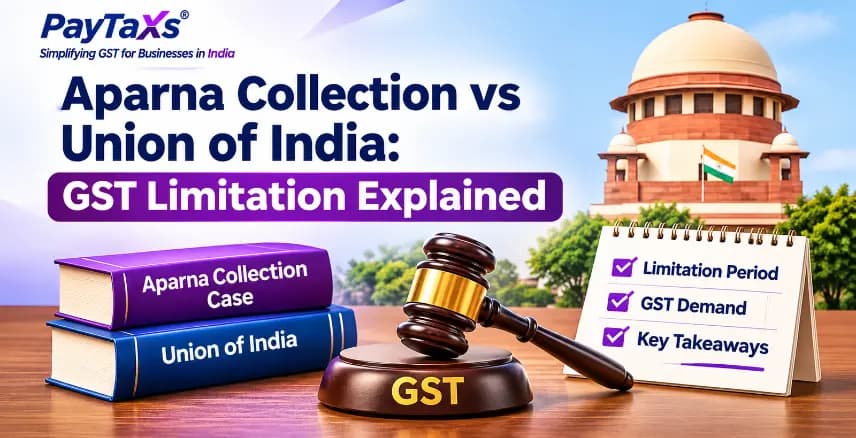
The Delhi High Court answered this in Aparna Collection vs Union of India, and the answer was no. For limitation under Section 74, the court looks at the date of the actual show cause notice and the actual order. The dates on DRC-01 and DRC-07 cannot, on their own, make a notice or an order time-barred. Below, we go through what happened in the case, what the court said, and what you should check in your own notice.
|
Point |
Details |
|---|---|
|
Case |
M/s Aparna Collection vs Union of India & Ors. |
|
Court |
Delhi High Court |
|
Bench |
Justices Anil Kshetarpal and Bharat Parashar |
|
Petitions |
W.P.(C) 3449/2026 and W.P.(C) 3501/2026 |
|
Decided on |
5 October 2026 |
|
Law involved |
Sections 74(2), 74(10) and 107 of the CGST Act, Rule 142 of the CGST Rules |
|
Result |
Time-bar argument rejected. Petitioner told to go to the Appellate Authority |
You can read the full order on Indian Kanoon.
Aparna Collection is a proprietorship firm. The department said it had taken input tax credit on invoices from suppliers that did not exist, with no real supply of goods behind them. Proceedings were started under Section 74, the section used when fraud, wilful misstatement, or suppression is alleged. The firm filed two writ petitions, one for each proceeding.
In the first matter, the show cause notices (SCNs) were dated 9 July and 11 July 2024. The DRC-01 forms for them were dated later, in the last week of August 2024.
In the second matter, the adjudication order was dated 29 January 2025. The DRC-07 for it came on 21 February 2025. That gap between the notice or order and the DRC form is what the whole case is about.
Fake supplier cases are common in trades like scrap, so a scrap dealer should also know the GST rules for RCM and TDS.
The firm said both proceedings were time-barred, and it used the dates on the DRC forms to prove it. For the SCNs, it said the last date under Section 74(2) was 4 August 2024. DRC-01 came after that date, so the notice was late. For the order, it said the last date under Section 74(10) was 4 February 2025. DRC-07 was dated 21 February 2025, so the order was late. The firm also said Section 74 should not have been used at all, because there was no real evidence of fraud or misstatement.
DRC-01 is a form on the GST portal that carries a summary of the show cause notice. When an officer issues an SCN under Section 73 or 74, a DRC-01 goes up on the portal with it. It shows the tax, interest, and penalty the department is asking for. Rule 142 of the CGST Rules says this clearly. The form is a summary. The notice itself is a separate document.
DRC-07 summarizes the final order. After the officer passes an order, the officer uploads a DRC-07 with the final tax, interest, and penalty. The amount then shows up in your electronic liability ledger on the portal. Rule 142(5) says the same thing for orders: the form is a summary, and the order is the real document.
Read More: E-Invoicing for RCM From 1 January 2027
The court rejected the time-bar argument. Its reasoning was simple.
Section 74(2) talks about issuing the notice. It does not say the DRC-01 must be issued within the time limit. The court said DRC-01 follows the notice and cannot take its place, so the limitation for the SCN is checked against the date of the SCN.
Section 74(10) talks about the order. It says the order must be passed within the time limit. It does not say that DRC-07 must be passed within that time. So limitation for the order is checked against the date of the order. The court also followed an earlier view of the same court in Rishi Enterprises, which said the same about DRC-07. In this case, the SCNs and the orders were all within time. The late DRC dates did not change that.
The time limit depends on which section the department uses, and that depends on the financial year.
|
Section |
Applies to |
Notice |
Order |
|
73 |
Up to FY 2023-24, no fraud alleged |
At least 3 months before the 3-year order deadline |
Within 3 years from the due date of the annual return |
|
74 |
Up to FY 2023-24, fraud, wilful misstatement or suppression alleged |
At least 6 months before the 5-year order deadline |
Within 5 years from the due date of the annual return |
|
74A |
FY 2024-25 onwards, both cases |
Within 42 months from the due date of the annual return |
Within 12 months of the notice, extendable by up to 6 months with reasons recorded |
The Aparna Collection case is about Section 74. The court's reasoning rests on the words of Sections 74(2) and 74(10). Section 74A is worded differently, so do not assume the same result without checking. GST rules and procedures keep changing, so also read the GST changes from 1 November 2026 before you act on an old notice.
For older years like FY 2017-18 to 2019-20, the government has also extended some time limits through notifications. So the last date has to be worked out year by year. The DRC forms sit outside this calculation. They are summaries, so the clock is checked against the notice and the order. Many ITC problems first show up when the annual return is filed, so it is better to fix a GSTR-9 ITC mismatch before you file.
The firm also wanted the court to say there was no fraud. The court did not go there.
It said whether fraud happened and whether the ITC is allowed are matters for the Appellate Authority under Section 107. The firm had taken part in the proceedings, and nothing showed that it was denied a hearing. That is why the court did not use its writ power under Article 226. A writ is meant for rare cases, like no jurisdiction or no hearing at all. When a proper appeal is available and the taxpayer was heard, the court usually sends the person to appeal. Both petitions were closed, and the firm was free to file statutory appeals.
If you got a GST notice or order and the DRC form shows a late date, do not stop there. A late DRC date by itself is a weak ground for a time-bar argument. Look at the actual notice and the actual order. If the SCN or the order itself was issued after the deadline, your argument is still alive. This judgment does not take that away. It only says that a late summary form is not enough.
Also, a writ petition is not a shortcut. If you were heard and the matter is about facts, like whether a supplier was real, expect the court to point you to the appeal. One more thing. Do not wait on appeal dates. They run from the order, so find the date first and plan around it. A regular GST reconciliation of your purchase records also helps you catch a doubtful supplier early.
Do this before you decide anything.
Open the actual show cause notice PDF, not only the DRC-01 form. Write down its date and reference number.
Note the date on DRC-01.
Open the final order and write down its date.
Note the date on DRC-07.
Find the financial year of the demand and the due date of that year's annual return.
Count the limit from the annual return due date and compare it with the notice date and the order date.
The notices and orders are in your GST portal login, under the User Services section. If the dates look wrong or you are not sure about the limit, show the papers to a GST practitioner or CA before you reply.
The Aparna Collection judgment sets out a clear point: for limitation under Section 74, look at the date of the notice and the date of the order. The DRC-01 and DRC-07 forms are only summaries and do not move the deadline. If you have a GST notice and want the dates and the limit checked, a GST practitioner can do it quickly. Paytaxs helps small businesses and traders with GST notices, replies and appeals.
This article is for general information and is not legal or tax advice. GST rules and court views can change, so please read the original order and the latest law before acting
Note: This guide is for information purposes only. The views expressed in this guide are personal and do not constitute the views of Paytaxs. Paytaxs or the author will not be responsible for any direct or indirect loss incurred by the reader for taking any decision based on the information or the contents. It is advisable to consult either a CA, CS, CPA or a professional tax expert from the Paytaxs team, as they are familiar with the current regulations and help you make accurate decisions and maintain accuracy throughout the whole process.
Shubham Jain is the Founder of SaveTaxs and has extensive experience in Indian and NRI taxation. He advises individuals, NRIs, and businesses on tax filing, tax planning, capital gains, DTAA benefits, fund repatriation, and compliance matters. He regularly writes about taxation and related financial topics. His focus is on making complex tax concepts easy to understand. Through his articles, he helps taxpayers stay informed, avoid common mistakes, and stay compliant with Indian tax laws. See Full Bio
Want to read more? Explore Blogs